
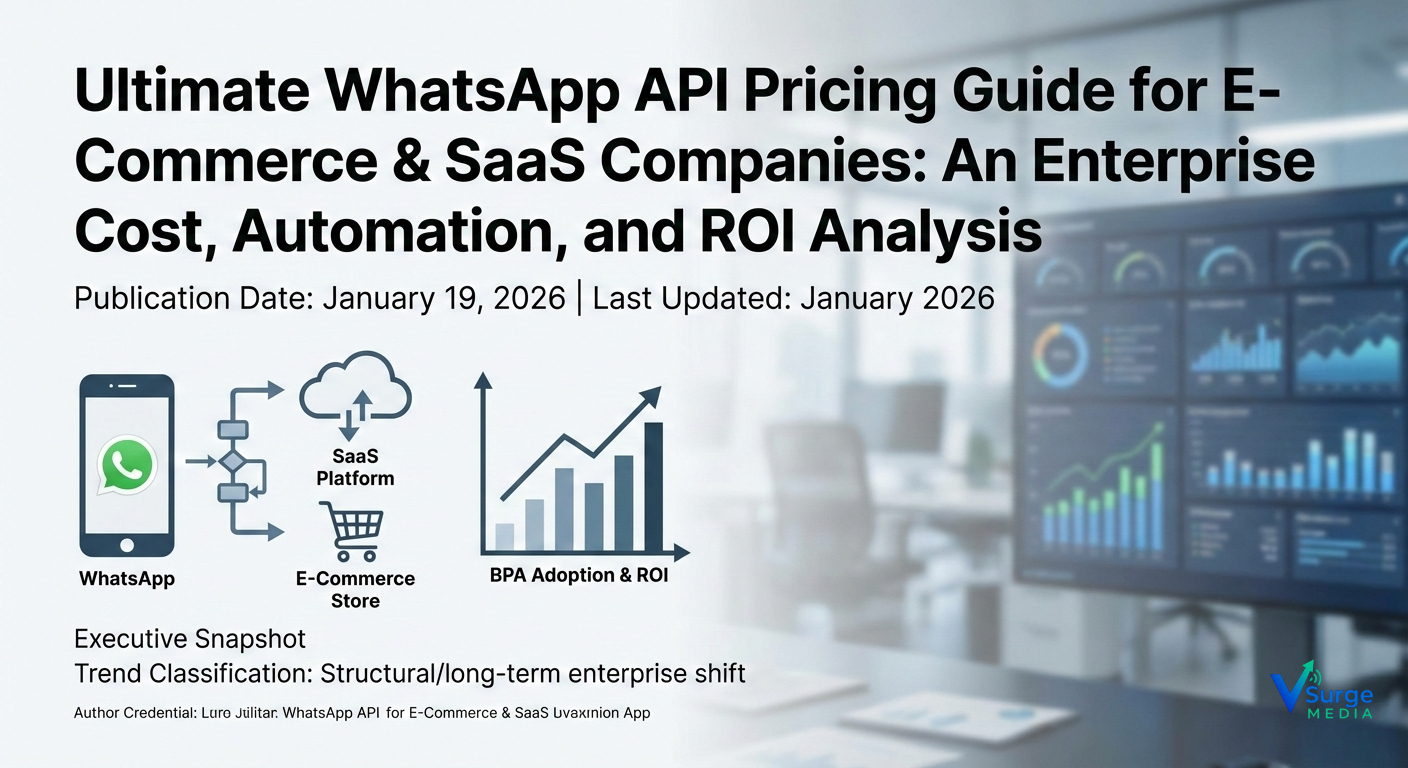
An enterprise cost, automation, and ROI analysis
Executive Snapshot
WhatsApp API pricing has shifted from a simple “per-message” cost into a strategic automation expense tied to customer experience, labour substitution, and workflow efficiency. For e-commerce and SaaS companies, the real cost question is no longer what WhatsApp charges, but how automation architecture converts conversation costs into operating leverage. This analysis explains what is confirmed, what is misunderstood, and what to expect over the next 3–6 months.
Trend Classification: Structural/long-term enterprise shift
Business Process Automation (BPA) adoption is not a short-cycle trend. Analyst consensus places it in the category of structural enterprise transformation, driven by labor economics, compliance pressure, and AI-assisted operations. WhatsApp API pricing sits inside this shift as a front-office automation cost, not a standalone messaging fee.
Why BPA Is Gaining Momentum Now
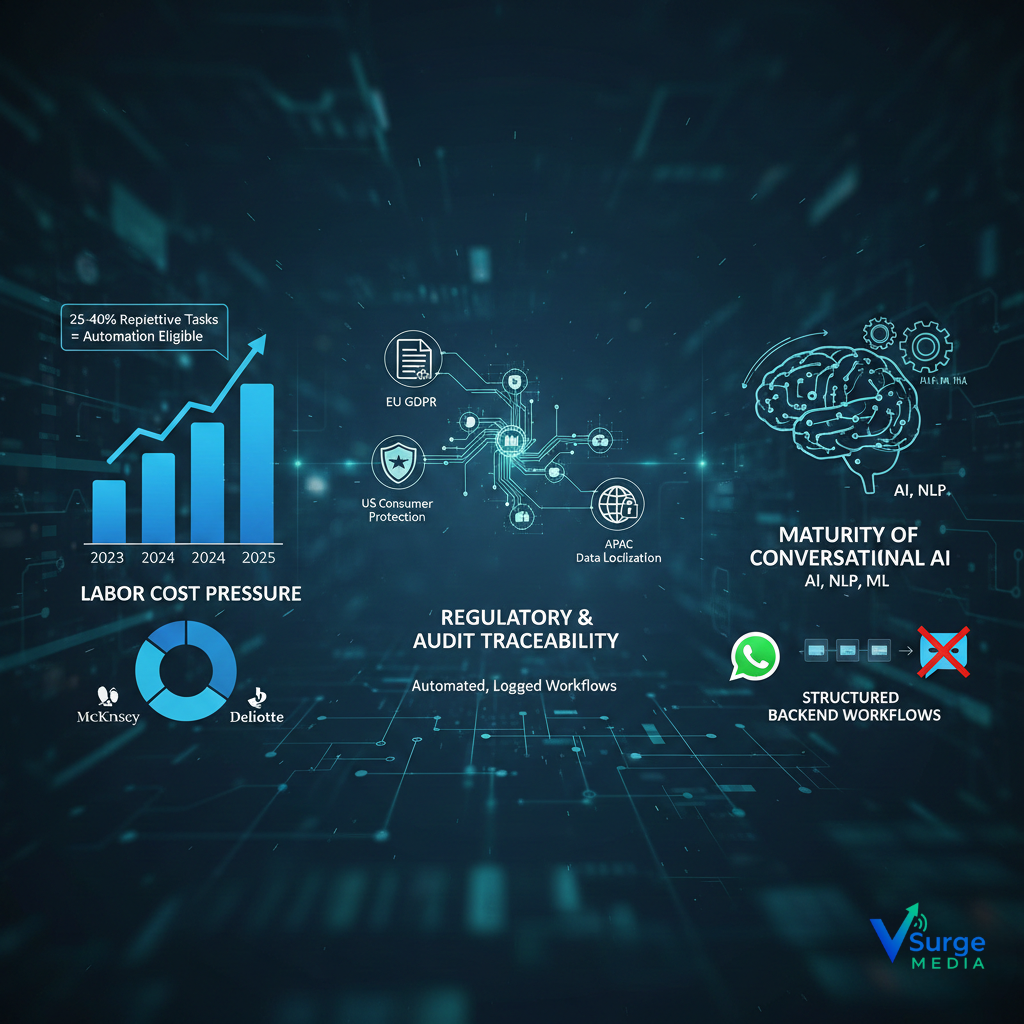
Three converging forces explain why BPA—and WhatsApp-based automation specifically—is accelerating:
- Labour cost pressure (2023–2025):
Consulting firms, including McKinsey and Deloitte, report that 25–40% of customer operations effort in digital-first firms is repetitive and rules-based, making it automation-eligible within current technology limits. - Regulatory and audit traceability:
EU GDPR, US consumer protection rules, and APAC data localization laws have increased the cost of manual customer communication. Automated, logged workflows reduce compliance exposure. - Maturity of conversational AI:
Advances in Artificial Intelligence (AI), particularly Natural Language Processing (NLP) and Machine Learning (ML), now allow WhatsApp conversations to trigger structured backend workflows instead of stopping at chat responses.
What Business Process Automation Actually Is (and Isn’t)
Business Process Automation (BPA) refers to the end-to-end automation of repeatable business workflows across systems, people, and data.
Hierarchy (explicit mapping)
- BPA – Umbrella discipline (process + technology)
- Robotic Process Automation (RPA) – Task-level UI automation
- Intelligent Automation (IA) – RPA + AI/ML/NLP/OCR
- Hyperautomation – Coordinated use of BPA, RPA, IA, process mining, and low-code platforms at scale
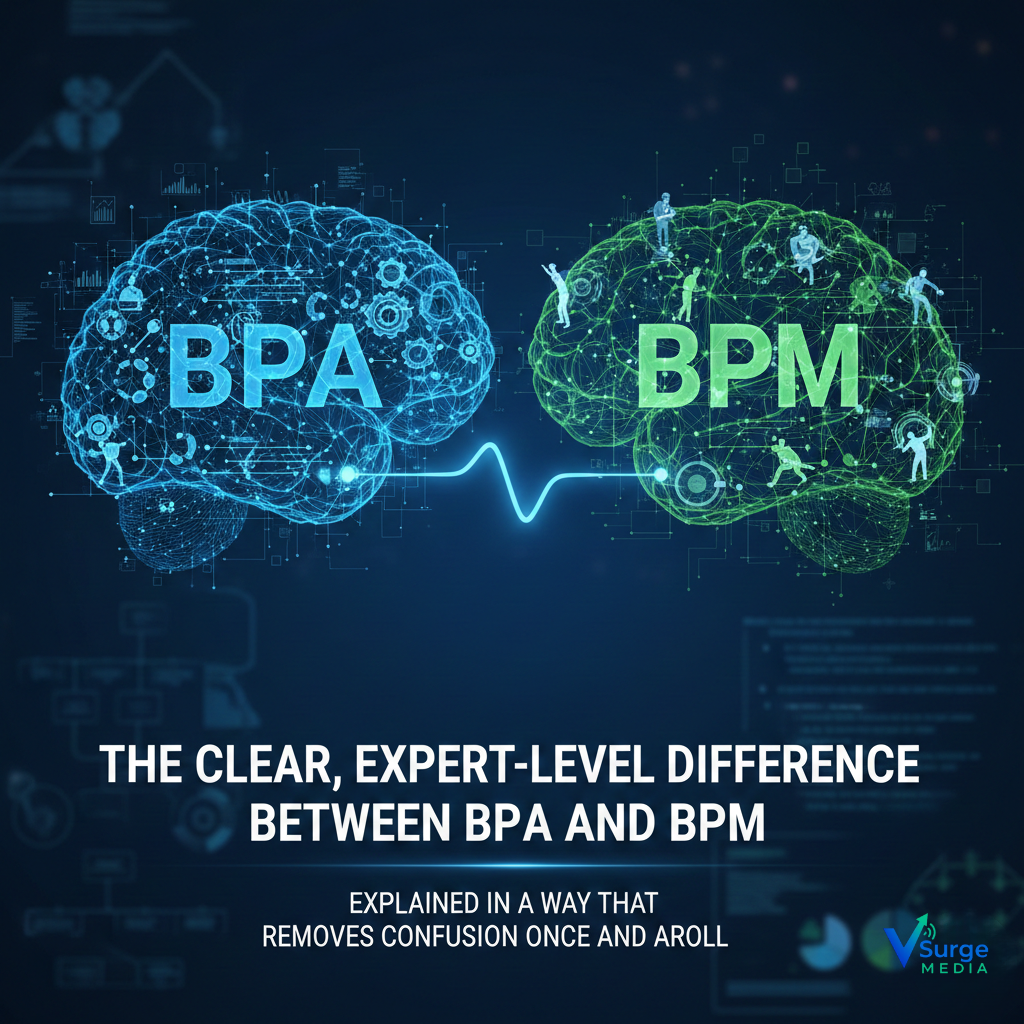
BPA vs BPM (often confused)
- Business Process Management (BPM) = design, model, govern processes
- BPA = execute and automate those processes
Most WhatsApp API implementations fail when BPM discipline is skipped.
Where WhatsApp API Pricing Fits in BPA Economics
WhatsApp API pricing (via the WhatsApp Business Platform) is conversation-based, not message-based. Charges vary by:
- Conversation category (utility, authentication, marketing, service)
- Country (regulatory and telecom factors)
- Volume tiers
Key enterprise insight:
WhatsApp API fees typically represent 10–25% of total automation cost. The larger cost drivers are workflow orchestration, integrations, and governance.
Automation Types & Cost Impact (Enterprise View)
| Automation Type | Typical Scope | Cost Structure | ROI Timeline |
|---|---|---|---|
| RPA | Single task automation | Tool licenses + setup | 3–6 months |
| IA | Task + decision support | AI services + data | 6–12 months |
| BPA | End-to-end workflows | Platform + integration | 6–18 months |
| Hyperautomation | Enterprise-wide | Programmatic | 12–24 months |
Source synthesis: Gartner Hyperautomation research (2024), Deloitte Automation Survey (2024).
Where Cost Savings Actually Come From
Confirmed savings mechanisms:
- Agent deflection: 20–35% reduction in human-handled tickets when WhatsApp automations cover FAQs and order status (industry case studies, 2023–2024).
- Cycle-time reduction: Order confirmation, onboarding, and support workflows shortened by 30–50%.
- Error reduction: Automated validation lowers rework and refunds.
Often ignored in coverage:
- Cost of process redesign
- Ongoing model training (NLP intents drift)
- Compliance audits and logging
Competitive Landscape (Neutral Comparison)
| Platform | Core Strength | Pricing Model | Ecosystem |
|---|---|---|---|
| IBM BPA | Governance & scale | Enterprise subscription | ERP, legacy |
| Kissflow | Low-code BPM | User/workflow based | SaaS-first |
| UiPath | RPA leadership | Bot-based | Broad |
| Automation Anywhere | Cloud RPA | Usage-based | Cloud-native |
WhatsApp API integrates on top of these platforms—it does not replace them.
What’s Confirmed vs What’s Still Unclear
Confirmed (high confidence)
- BPA reduces operating costs when processes are stable.
- WhatsApp automation improves response times and CSAT.
- ROI is process-specific, not channel-specific.
Still uncertain
- Long-term cost of AI inference at scale
- Regulatory constraints on conversational data retention
- Vendor pricing stability beyond 2026
Risks, Constraints & Failure Modes
- Process debt: Automating broken workflows accelerates failure.
- Over-automation: Not all customer interactions should be automated.
- Vendor lock-in: Proprietary WhatsApp tooling without abstraction layers.
Outlook: Next 3–6 Months (Time-Bound)
- Increased scrutiny on WhatsApp marketing conversation costs
- Shift toward process mining to identify automation candidates
- CFO involvement in automation ROI governance
No evidence suggests a slowdown in BPA investment in this window.
Direct Answers to Executive Questions
How much does business process automation cost?
Enterprise BPA programs typically range from the low six figures to seven figures annually, excluding WhatsApp conversation fees.
Which processes should be automated first?
High-volume, rules-based, low-exception workflows (order status, onboarding, ticket triage).
How long does it take to see ROI?
RPA: 3–6 months; BPA programs: 6–18 months.
What are the main risks?
Poor process design, compliance gaps, and unrealistic AI expectations.
Which industries see the highest ROI?
E-commerce, SaaS, fintech, logistics, and telecom.
FAQ (C-Suite Focused)
Is WhatsApp API pricing increasing?
Pricing varies by geography and category; no universal increase trend is confirmed as of 2025.
Does WhatsApp automation replace support teams?
No. It reallocates human effort to exception handling and retention.
Glossary (Quick Reference)
- BPA: End-to-end workflow automation
- RPA: UI-level task automation
- IA: Automation enhanced by AI/ML/NLP/OCR
- Hyperautomation: Scaled, coordinated automation strategy
- Process Mining: Data-driven process discovery
Author Credential Note
Written by a senior digital transformation strategist and investigative business journalist with 25+ years of experience covering enterprise automation, operational economics, and AI-driven systems.
Conclusion
WhatsApp API pricing should be evaluated as automation infrastructure spend, not messaging overhead. Organizations that connect conversation costs to BPA outcomes see predictable ROI; those that don’t often misclassify automation as a marketing expense and underperform.

#WhatsAppAPIPricing #BusinessProcessAutomation #EnterpriseAutomation #AutomationROI #BPA #RPA #IntelligentAutomation #Vsurgemedia #Hyperautomation #DigitalTransformation #CFOInsights #EnterpriseSaaS #CustomerAutomation #AIinBusiness #ProcessAutomation