

Business process automation (BPA) is not new, but CEO/CFO interest has surged sharply over the past quarter. The acceleration is tied to cost-reduction mandates, post-AI integration pressure, and a renewed shift from experimentation to measurable operational efficiency.
Business Process Automation is experiencing a renewed surge as executive teams seek predictable, non-speculative cost reductions. While vendors advertise savings “up to 40%,” the real significance is that enterprises are now pairing workflow automation, RPA, AI, and process intelligence into unified operating models. This article examines why BPA is trending now, what triggers are driving executive urgency, what remains unresolved, and what the next 3–6 months realistically look like.
1. Why BPA Is Trending Now
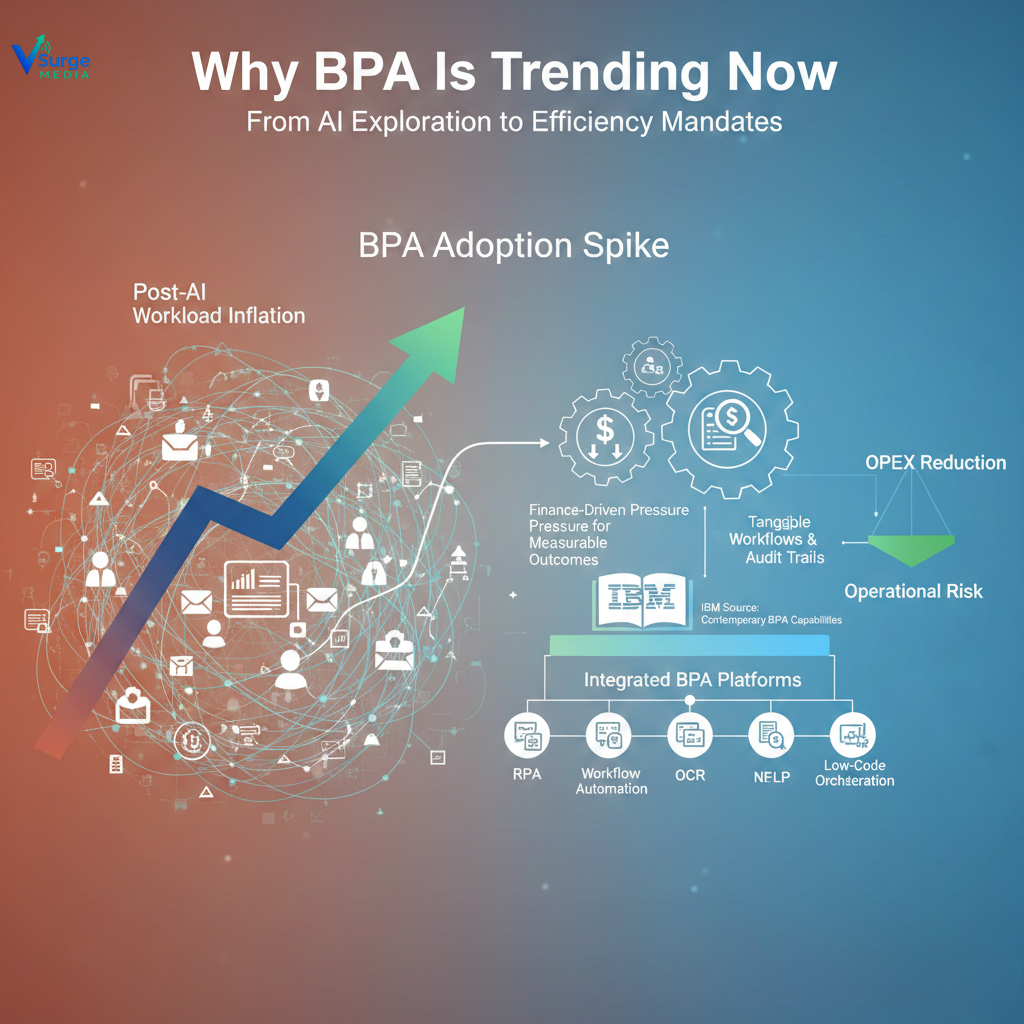
Across industries, board directives have shifted from AI exploration to AI efficiency mandates. Teams are no longer asking whether automation is possible but whether it can reliably reduce OPEX without introducing operational risk.
Three triggers explain the current spike in BPA adoption:
- Post-AI workload inflation
AI has accelerated content, support, and operational throughput — but it has also created new manual oversight tasks. Companies are automating the downstream processes that AI inadvertently expands. - Finance-driven pressure for measurable outcomes
CFOs want cost cuts that can be tied to transparent workflows, not algorithmic black boxes. BPA provides tangible workflows and traceable audit trails. - Maturity of platforms integrating RPA, workflow automation, and AI
Tools now bundle workflow engines, robotic process automation, optical character recognition, NLP, and low-code orchestration more cohesively — traits documented in IBM’s overview of contemporary BPA capabilities, IBM Source.
These forces have aligned to make BPA a medium-cycle priority trend rather than a short burst of hype.
2. What Business Process Automation Actually Is
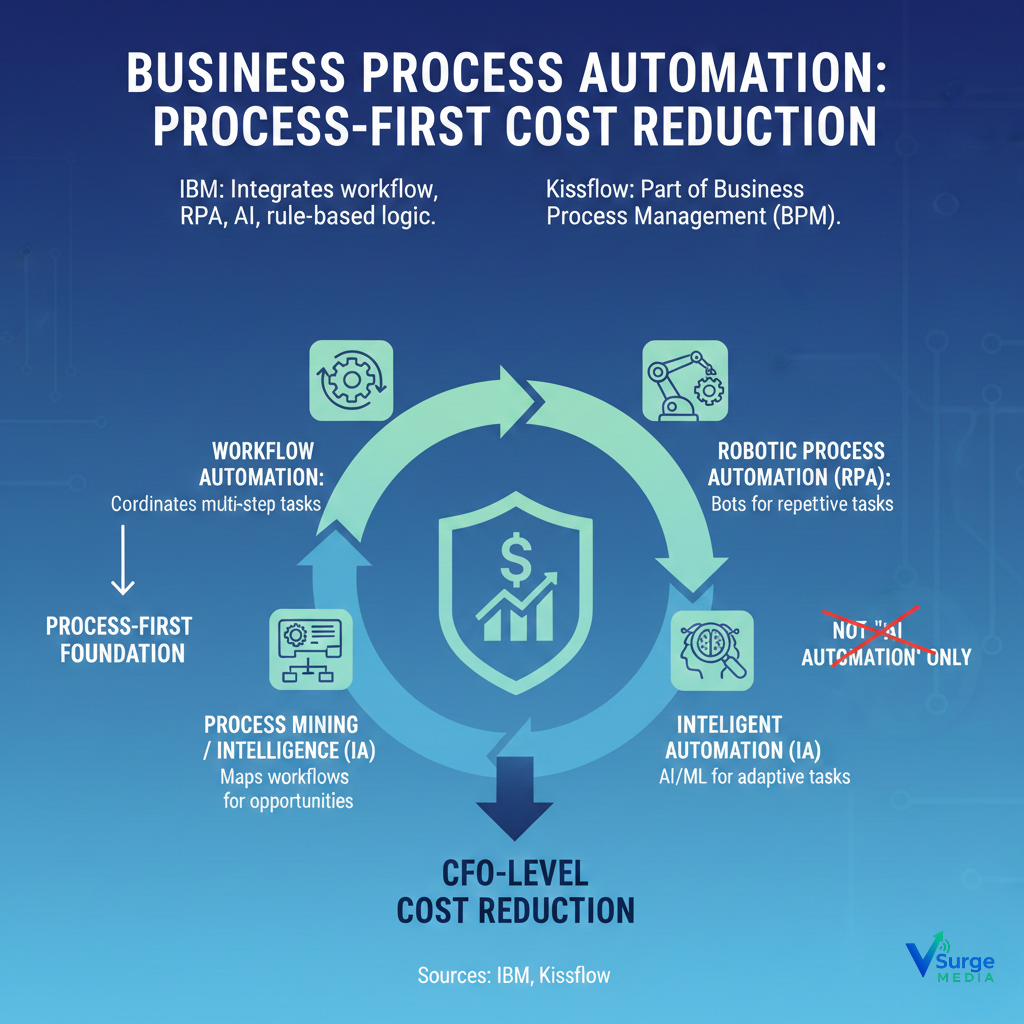
According to IBM and Kissflow, Business Process Automation uses technology to automate repeatable business activities, usually within structured workflows that span multiple departments.
Sources:
• IBM: BPA integrates workflow automation, RPA, AI, and rule-based logic
• Kissflow: BPA sits within the broader Business Process Management (BPM) discipline
BPA is often confused with “AI automation,” but they are not the same. BPA is process-first, meaning automation is applied only after analysing the current process flow.
Core components include:
- Workflow Automation: Coordinates multi-step tasks across teams.
- Robotic Process Automation (RPA): Software bots perform repetitive, high-volume tasks.
- Intelligent Automation (IA): Adds AI and ML to handle semi-structured or adaptive tasks.
- Process Mining / Intelligence: Discovers and maps real operational workflows to identify automation opportunities.
This process-first foundation is critical for CFO-level cost reduction.
3. What BPA Includes Today (confirmed capabilities)
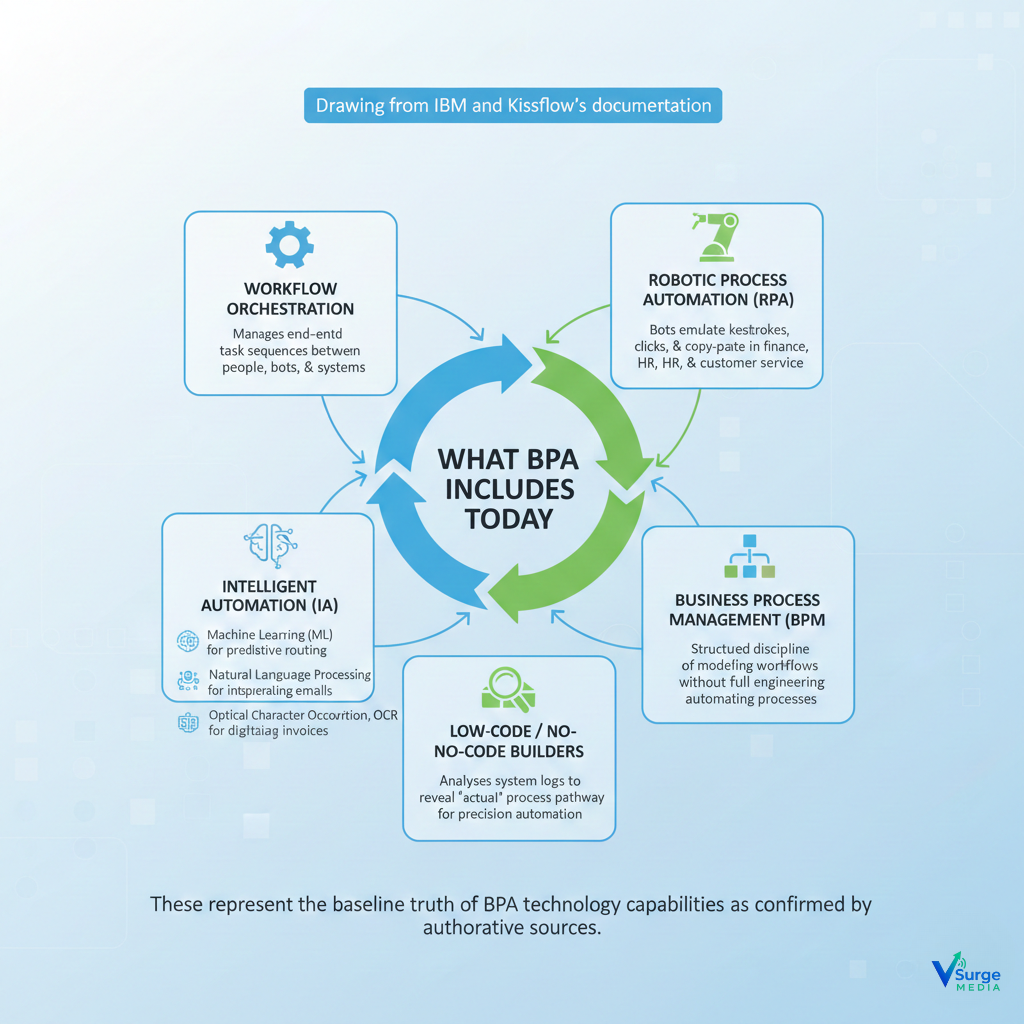
Drawing from IBM and Kissflow’s documentation, the following capabilities represent the confirmed definition of BPA:
Workflow Orchestration
Tools that manage end-to-end task sequences, ensuring work moves efficiently between people, bots, and systems.
Robotic Process Automation (RPA)
Bots that emulate keystrokes, clicks, and copy-paste tasks in finance, HR, and customer service operations.
Intelligent Automation (IA)
Combines RPA with AI elements such as:
- Machine Learning (ML) for predictive routing
- Natural Language Processing (NLP) for interpreting emails and support tickets
- Optical Character Recognition (OCR) for digitising invoices, forms, and documents
Business Process Management (BPM)
The structured discipline of modelling, improving, and automating processes.
Low-code / No-code Builders
Allow business teams (operations, finance, HR) to build or modify workflows without full engineering dependencies.
Process Mining
Analyses system logs to reveal the “actual” process pathway — often different from documented workflows — enabling precision automation.
These represent the baseline truth of BPA technology capabilities as confirmed by authoritative sources.
4. Why This Matters — The Real Executive Impact
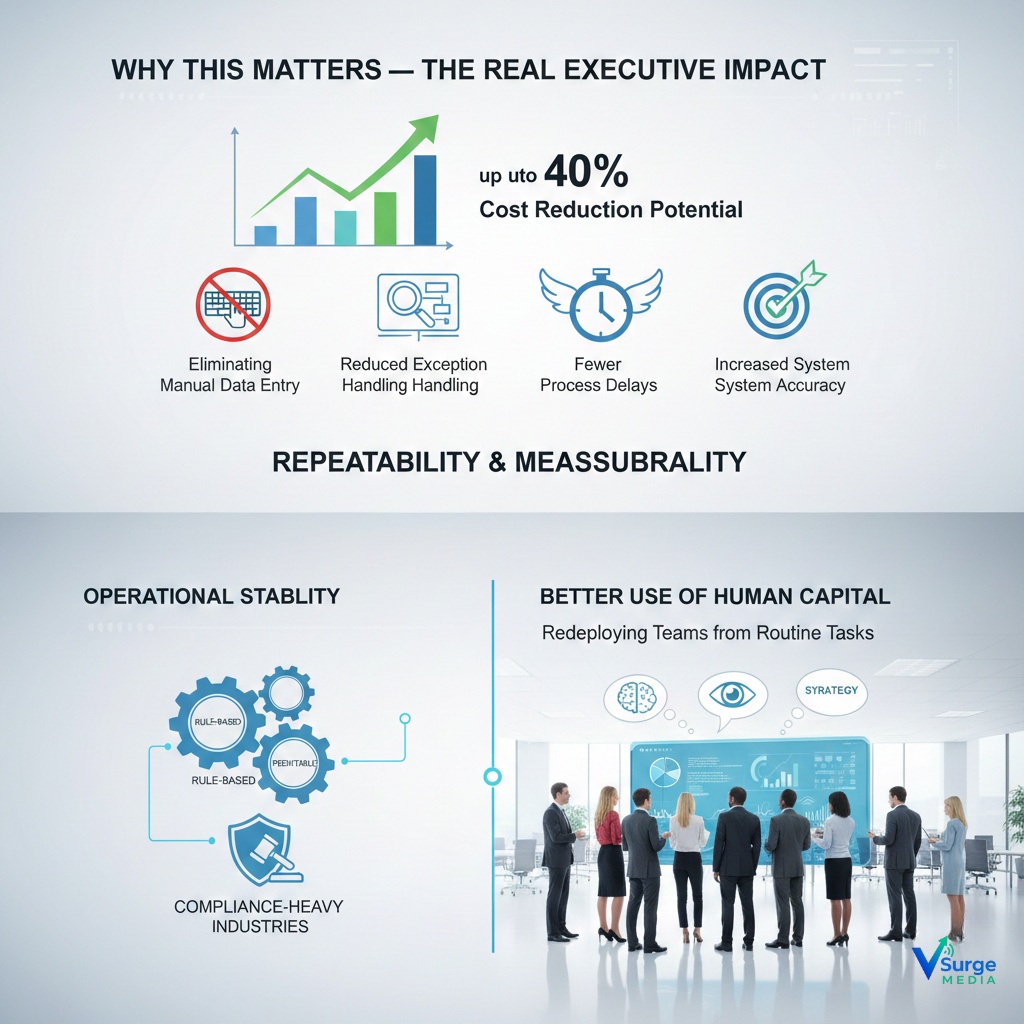
Cost Reduction Potential (Contextualised, Not Fabricated)
Reports often claim that BPA can reduce costs by “up to 40%.”
This is not guaranteed, but the number typically represents:
- Savings from eliminating manual data entry
- Reduction in exception handling volume
- Fewer process delays
- Increased system accuracy (reducing rework)
The relevance for CEOs and CFOs is less about the exact percentage and more about the repeatability and measurability of the savings.
Operational Stability
Unlike generative AI outputs, BPA processes are:
- rule-based
- auditable
- predictable
This makes them suitable for compliance-heavy industries.
Better Use of Human Capital
Automation allows organisations to redeploy teams from routine tasks toward analysis, oversight, and strategy — a theme echoed in both IBM and Kissflow’s frameworks.
5. Competitive Context — How BPA Fits Into the Automation Landscape
The automation sector has broadened beyond legacy RPA vendors to include:
- Hyperautomation platforms integrating workflow + RPA + AI
- Low-code enterprise suites targeting non-technical teams
- Cloud-native BPM engines optimised for large-scale orchestration
What differentiates BPA today is not a single technology but the convergence of previously siloed capabilities:
- RPA bots without workflow logic are fragile
- AI without process modelling produces inconsistent results
- BPM without automation offersa limited measurable ROI
BPA is the unifying strategy that makes these components interoperable.
6. What’s Confirmed vs What’s Not Yet Confirmed
✅ Confirmed (based on IBM + Kissflow sources)
- BPA includes workflow automation, RPA, AI elements (ML/NLP), OCR, and BPM.
- BPA is used for repetitive, rules-based business processes.
- Low-code/no-code tools are increasingly part of BPA adoption.
- Process mining is used to identify automation-ready tasks.
❓ Unconfirmed / Unclear
- The exact percentage of cost savings across industries
- Universal shortcuts for deploying BPA across large-scale enterprises
- Long-term AI dependencies (many vendors are still evolving their models)
- Standardisation of intelligent automation frameworks across platforms
These uncertainties are operational rather than conceptual.
7. Risks, Criticism & Limitations
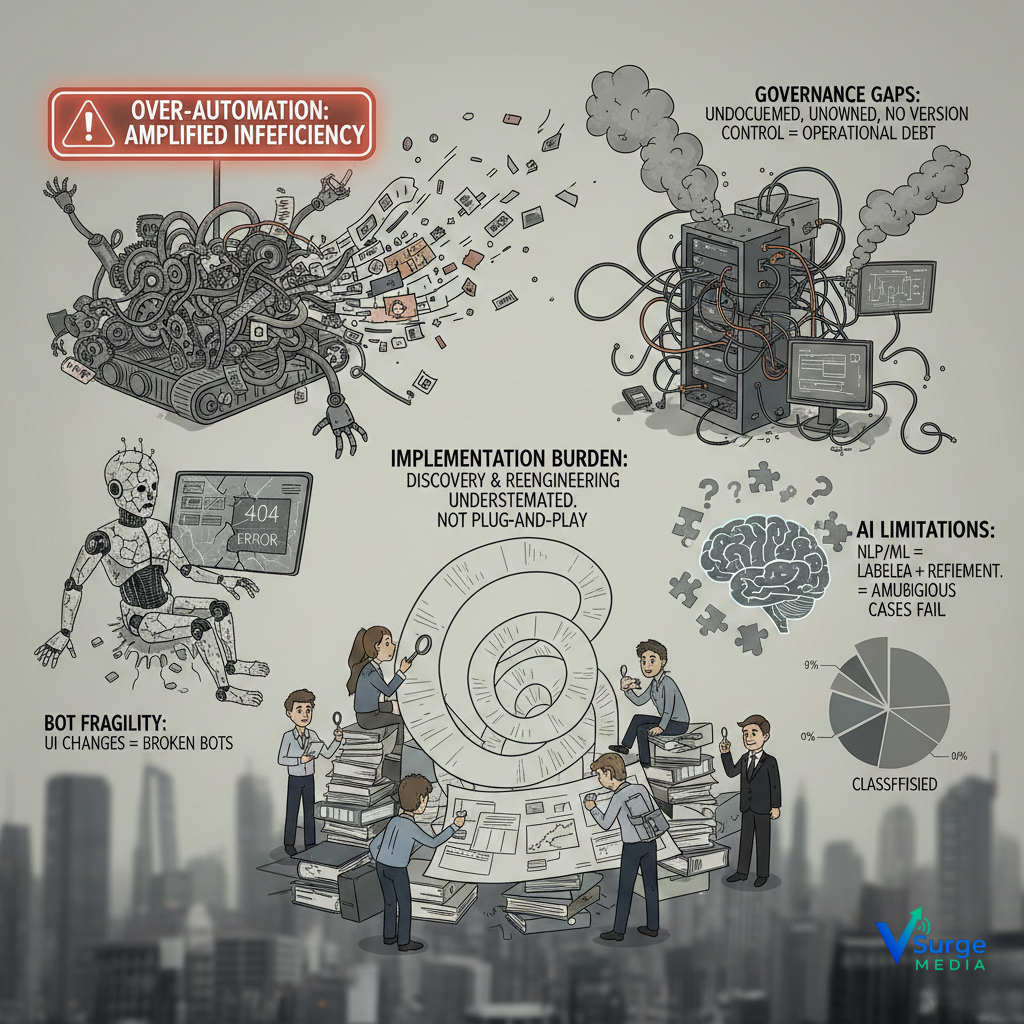
Over-automation
Deploying automation in poorly designed processes can amplify inefficiencies.
Bot fragility
RPA bots break when UI layouts change, requiring ongoing maintenance.
Implementation burden
Organisations underestimate the discovery and reengineering phases.
BPA is not “plug-and-play.”
Governance gaps
Insufficient documentation, inconsistent ownership, and lack of version control can create long-term operational debt.
AI limitations
NLP and ML require labelled data and continuous refinement; they do not reliably handle ambiguous cases.
8. Outlook — What Happens Next (3–6 Months)
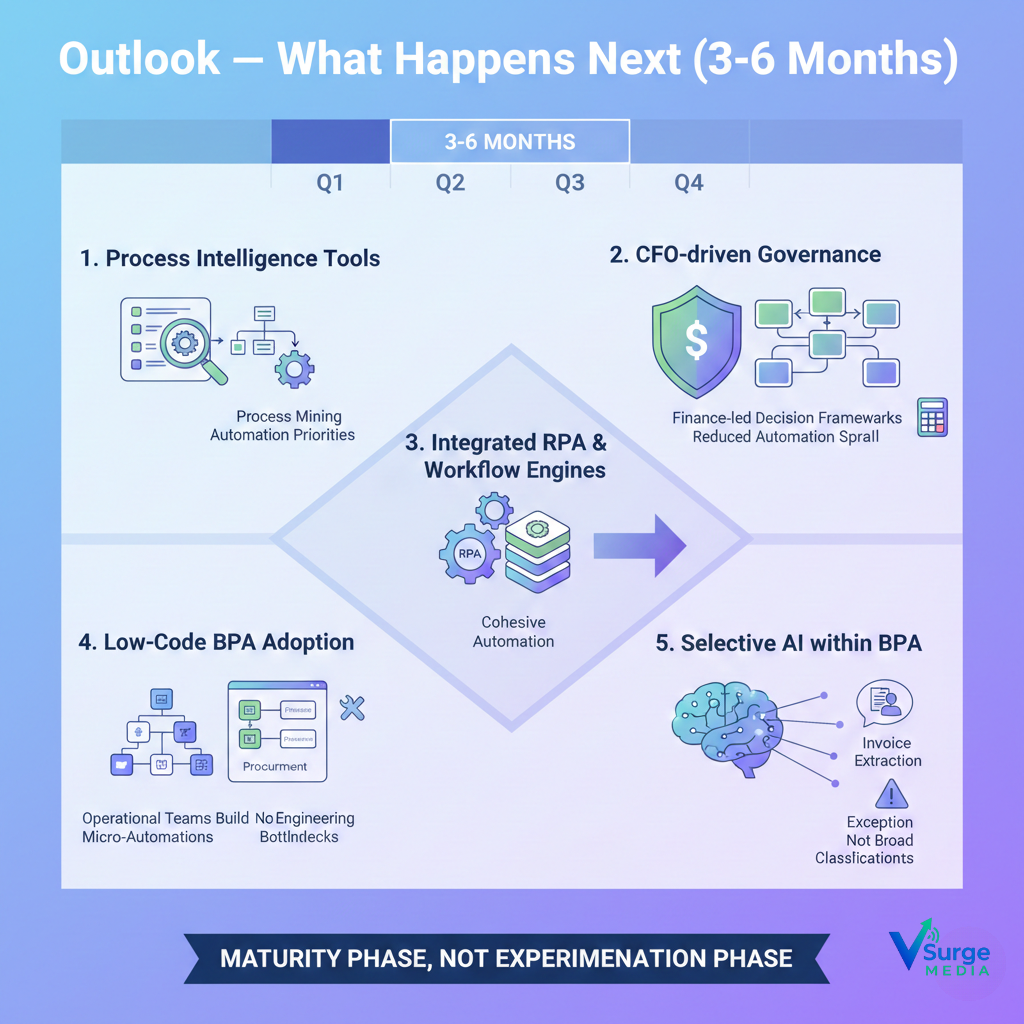
Based on observable patterns and historical cycles, the BPA trend over the next quarter will likely be characterised by:
1. Expansion of Process Intelligence Tools
Companies will lean on process mining to identify automation priorities before committing budget.
2. CFO-driven governance models
Expect more finance-led decision frameworks to reduce automation sprawl.
3. Tight integration between RPA and workflow engines
Vendors are pursuing cohesive automation stacks rather than modular tools.
4. Increased adoption of low-code BPA
Operational teams will build micro-automations to support finance, HR, and procurement workflows without engineering bottlenecks.
5. Selective use of AI within BPA
AI will be applied narrowly — invoice extraction, email routing, exception classification — not as broad replacements for human judgment.
This reflects a maturity phase, not an experimentation phase.
9. Conclusion
Business Process Automation is trending again because it fits the current enterprise mandate: measurable efficiency, operational resiliency, and predictable cost reduction. BPA’s real value lies not in “AI replacing humans” but in process-driven automation frameworks combining workflow orchestration, RPA, AI components, and process intelligence (Vsurgemedia).
The next 3–6 months will be defined by governed automation, not hype-driven rollouts.

#BPA #BusinessProcessAutomation #ProcessAutomation #Automation #AI #ArtificialIntelligence #RPA (Robotic Process Automation) #DigitalTransformation