
How San Francisco’s Dark-Horse Position Mirrors Modern Marketing Campaign Strategies
The NFC West playoff picture has become one of the most compelling narratives in professional football, and surprisingly, it offers valuable lessons for digital marketing professionals. As the San Francisco 49ers position themselves as potential dark-horse contenders for both the division title and the NFC’s No. 1 overall seed, their strategic approach mirrors how AI-driven marketing campaigns can pivot and adapt to changing competitive landscapes.
The Current Playoff Picture: A Data-Driven Analysis
The battle for NFC West supremacy has evolved into a fascinating three-way race. While the Los Angeles Rams and Seattle Seahawks have dominated headlines throughout the season, the 49ers are strategically positioned to capitalize on their competitors’ matchups—much like how smart digital marketers leverage competitor analysis and market positioning data.
With Thursday Night Football featuring a critical Seahawks-Rams showdown, the 49ers find themselves in an unusual position: rooting for Seattle. This counterintuitive strategy demonstrates how understanding the broader ecosystem can create unexpected opportunities.
If Seattle emerges victorious, San Francisco would suddenly control its own destiny for both the NFC West title and the conference’s top seed. This scenario exemplifies the importance of scenario planning—a crucial element in both sports strategy and digital marketing campaign management.
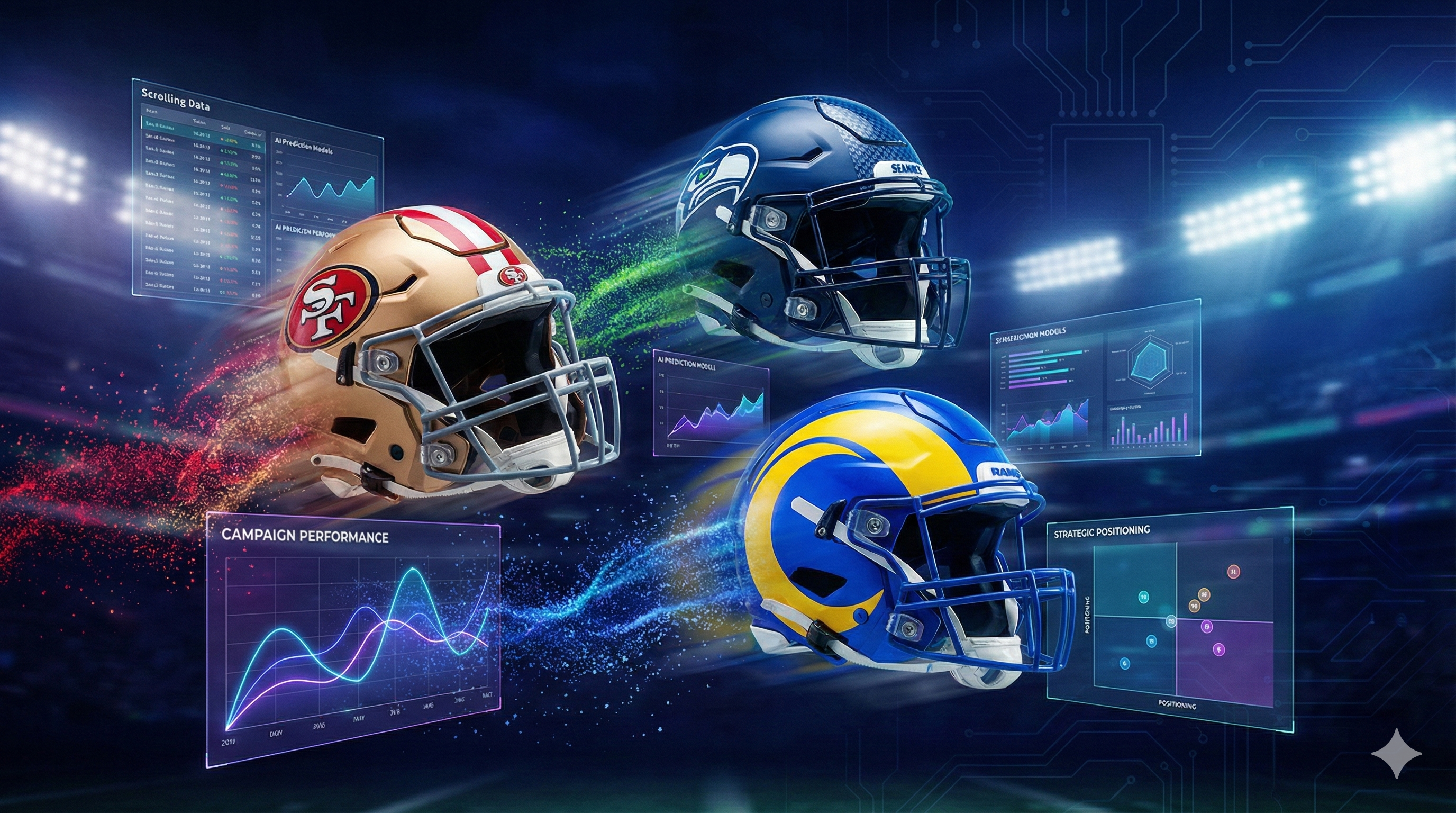
Strategic Path to Success: The Power of Predictive Analytics
The 49ers’ pathway to playoff dominance requires winning out against a challenging schedule:
- Week 16: at Indianapolis Colts (8-6)
- Week 17: Chicago Bears (10-4)
- Week 18: Seattle Seahawks (11-3)
This represents a remaining strength of schedule of .690, tied for the hardest in the NFL. Yet, if executed perfectly, the mathematics work in San Francisco’s favor due to head-to-head tiebreakers against both the Seahawks and Bears.
AI-Powered Decision Making in Sports and Marketing
Modern NFL teams increasingly rely on AI-driven analytics to evaluate complex scenarios like playoff positioning. Similarly, digital marketing agencies now leverage artificial intelligence for:
- Predictive customer behavior modeling
- Campaign performance forecasting
- Competitive positioning analysis
- Real-time strategy optimization
Just as the 49ers must analyze multiple outcome scenarios, digital marketers use AI tools to model various campaign trajectories and identify the optimal path forward.
The Tiebreaker Scenario: How Data Points Create Competitive Advantages
The NFL’s tiebreaker system provides a perfect analogy for digital marketing KPI hierarchies. Here’s how the 49ers would win if they finish 13-4:
- Head-to-head tiebreaker advantage over Seahawks and Bears
- Division record superiority (5-1 vs. Rams’ potential 4-2)
- Conference record as the next determining factor
This hierarchical decision-making framework mirrors how marketing teams should prioritize metrics:
- Primary KPIs (conversion rates, ROI)
- Secondary indicators (engagement metrics, reach)
- Tertiary measures (brand awareness, social sentiment)
Machine Learning and Strategic Positioning
Current oddsmakers’ predictions heading into Thursday night reflect probability models similar to those used in marketing attribution:
- Rams (11-3): -160 odds
- Seahawks (11-3): +200 odds
- 49ers (10-4): +700 odds
These odds demonstrate how AI-powered predictive models assign probabilities to various outcomes. Digital marketing professionals can apply similar machine learning techniques to forecast campaign success rates, customer lifetime value, and market share projections.
The Technology Behind Modern Sports Analytics
NFL teams now employ sophisticated AI systems that process:
- Player performance metrics
- Historical matchup data
- Weather and environmental factors
- Injury probabilities
- Opponent tendencies
Digital marketing agencies utilize comparable technology stacks:
- Customer data platforms (CDPs) for unified audience insights
- Marketing automation powered by machine learning
- Programmatic advertising with real-time bidding algorithms
- Natural language processing for sentiment analysis
- Computer vision AI for creative optimization
Lessons for Digital Marketing Teams
The 49ers’ strategic positioning offers several takeaways for marketing professionals:
1. Monitor the Competitive Landscape Continuously
Just as San Francisco tracks Rams and Seahawks performances, marketing teams must maintain real-time competitive intelligence through AI-powered monitoring tools.
2. Scenario Planning Creates Opportunities
Understanding multiple potential outcomes allows teams to position themselves advantageously. Marketing teams should model various market scenarios and prepare response strategies.
3. Control What You Can Control
The 49ers must win out regardless of other outcomes. Similarly, marketing teams should focus on optimizing controllable variables while monitoring external factors.
4. Leverage Data for Decision-Making
Both sports teams and marketing agencies benefit from AI-driven insights that identify optimal strategies based on historical patterns and predictive modeling.
5. Head-to-Head Advantages Matter
Building direct competitive advantages (like the 49ers’ tiebreakers) parallels creating unique value propositions and proprietary marketing capabilities that competitors cannot easily replicate.
The Role of AI in Modern Marketing Strategy
As the 49ers use advanced analytics to navigate their playoff path, marketing agencies increasingly depend on artificial intelligence for:
Campaign Optimization:
Machine learning algorithms continuously adjust targeting, creative, and bidding strategies to maximize ROI—similar to how coaches adjust game plans based on real-time performance data.
Audience Intelligence:
AI-powered tools segment audiences with precision comparable to how NFL teams analyze opponent weaknesses and strengths.
Predictive Modeling:
Just as sports analytics predict game outcomes, marketing AI forecasts customer behavior, churn probability, and lifetime value.
Content Personalization:
Natural language generation and recommendation engines deliver personalized experiences at scale, much like how teams customize game plans for specific opponents.
Looking Ahead: The Final Push
The remaining weeks will determine whether the 49ers’ strategic positioning pays off. Similarly, Q4 and Q1 often represent crucial periods for marketing teams to achieve annual objectives.
The NFC West race demonstrates that success requires:
- Strategic vision beyond immediate circumstances
- Data-driven decision-making at every juncture
- Execution excellence when opportunities arise
- Adaptability as competitive dynamics shift
For digital marketing professionals, these same principles apply whether launching new campaigns, entering competitive markets, or optimizing existing initiatives.
Conclusion: Strategy, Technology, and Execution
The battle for NFC West supremacy illustrates how strategic positioning, data analytics, and execution excellence combine to create competitive advantages. As AI and machine learning technologies continue evolving, both sports organizations and marketing teams gain increasingly sophisticated tools for navigating complex competitive landscapes.
Whether the 49ers successfully capitalize on their opportunity remains to be seen. However, their strategic approach—leveraging data, understanding tiebreakers, and controlling their own destiny—provides valuable lessons for any organization seeking to outmaneuver competitors in dynamic markets.
At [Your Agency Name], we leverage AI-powered analytics and strategic positioning to help clients dominate their competitive landscapes. Just as championship teams combine strategy with execution, our data-driven approach delivers measurable results in the ever-evolving digital marketplace.