
By Vsurgemedia | Retail Technology Series
Executive Summary:
There is no faster way to lose a customer than to say, “Sorry, we are out of stock,” after they have already paid. In 2026, inventory accuracy isn’t just about counting boxes; it is about synchronizing your physical warehouse with your digital storefronts in real-time.
For most owners, finding the right inventory management software small business needs is a nightmare of expensive demos and broken promises. According to Shopify’s Commerce Trends, 43% of small businesses still track inventory manually or don’t track it at all. This leads to Dead Stock (cash tied up in dust) and Stockouts (lost revenue).
This guide provides an unbiased review of the top inventory management software small business owners rely on, comparing cost, barcode features, and integration capabilities.
Part 1: The High Cost of “Excel Inventory”
Before upgrading to professional inventory management software small business tools, you need to calculate the cost of your current manual process.
The “Hidden” Costs of Manual Tracking:
- The “Ghost” Inventory: You think you have 5 units, but the shelf is empty. Result? A cancelled order and a 1-star review.
- Dead Stock: You keep buying Item A because you think it sells, but Item B is actually your bestseller. Without data, you invest in the wrong stock.
- The “Channel Conflict”: You sell the last item on Amazon, but your Shopify store still shows it as available. Now you are in trouble with Amazon’s algorithm.
Part 2: Top Inventory Management Software Small Business Reviews (2026)
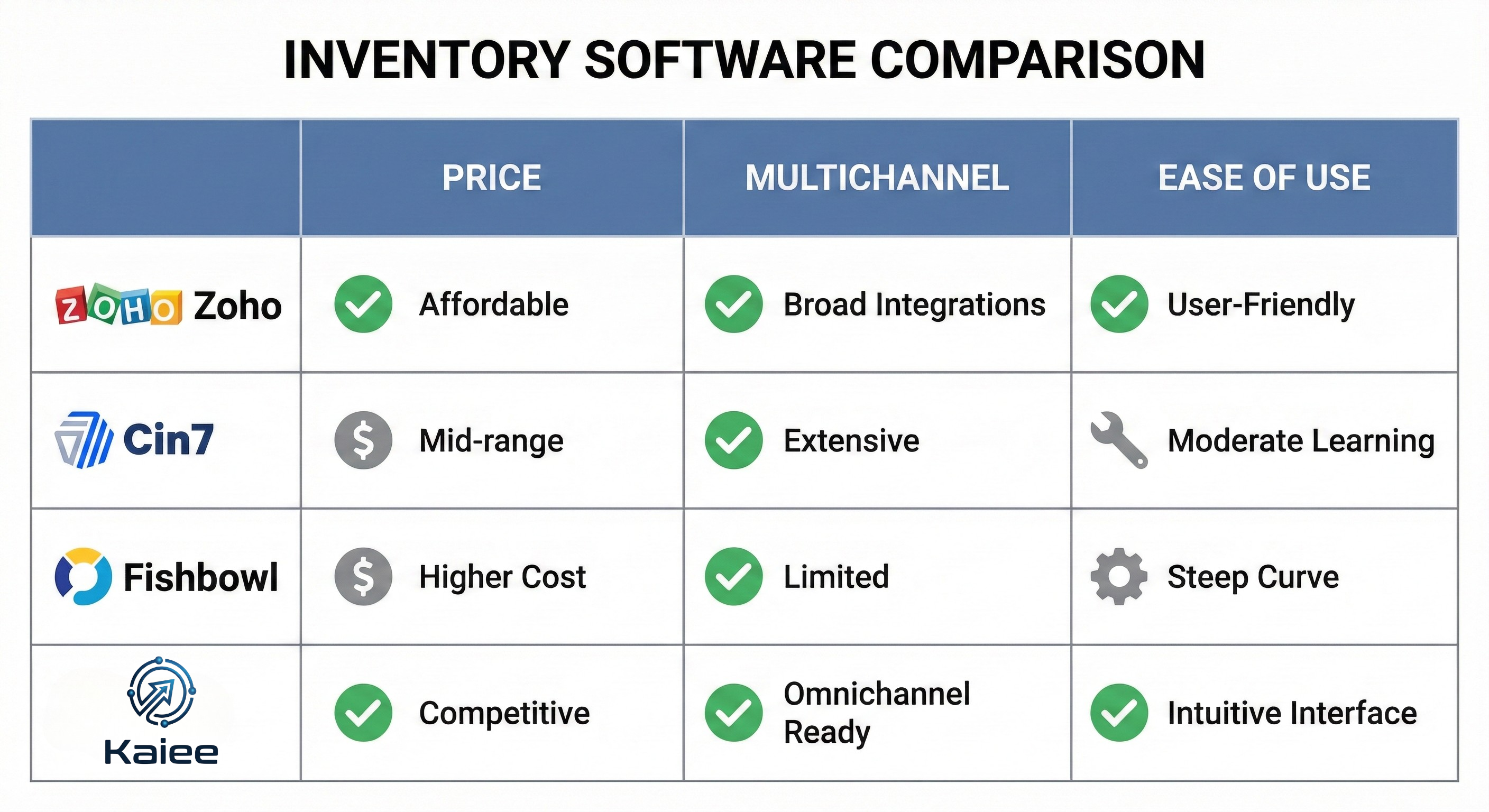
We evaluated 20+ platforms based on Ease of Use, Multichannel Sync, and Price.
1. Zoho Inventory (The Budget King)
The Verdict: The best entry-level inventory management software small business owners can buy. If you are already in the Zoho ecosystem, this is a no-brainer.
- Pros:
- Price: Has a generous free tier and affordable paid plans.
- Shipping: Integrates deeply with major shipping carriers to print labels.
- Kitting: Allows you to bundle items (e.g., “Gift Basket” = 1 Mug + 1 Coffee Pack).
- Cons:
- Scalability: Can struggle with high-volume enterprise data.
- Sync Speed: Not always “real-time” instant for high-frequency trading.
- Best For: Startups and Low-SKU businesses.
2. Cin7 Core (formerly DEAR Systems)
The Verdict: The powerhouse for omnichannel sellers. If you sell on Shopify, Amazon, and a physical store, Cin7 is the industry leader.
- Why it wins: It serves as a mini-ERP (Enterprise Resource Planning) tool.
- Pros:
- B2B Portal: Allows your wholesale customers to order from a private catalog.
- Manufacturing: Handles “Bill of Materials” (raw materials -> finished goods).
- POS: Built-in Point of Sale system.
- Cons:
- Cost: Expensive ($300+/month).
- Complexity: Steep learning curve.
- Best For: Growing brands with multiple sales channels.
3. Fishbowl (The QuickBooks Companion)
The Verdict: If your accountant lives in QuickBooks, Fishbowl is the bridge between your warehouse and your books.
- Pros:
- Accounting Sync: The best integration with QuickBooks Desktop/Online.
- Warehouse: Strong barcode scanning and asset tracking features.
- Cons:
- UI: The interface feels dated compared to modern SaaS.
- Server: Often requires a server setup (though they have a hosted version now).
- Best For: Manufacturers and Distributors.
4. Sortly (The Visual Tracker)
The Verdict: The simplest inventory management software small business teams can use without training.
- Pros:
- Visuals: Highly photo-based. You organize items by pictures, not just SKUs.
- Mobile App: Turns your phone into a barcode scanner instantly.
- QR Codes: Generates custom QR labels for your shelves.
- Cons:
- Integrations: Weak on the e-commerce side (Shopify/Amazon sync is limited).
- Best For: Internal inventory (IT assets, construction tools, medical supplies).
5. inFlow Inventory (The B2B Specialist)
The Verdict: A solid middle-ground between Sortly and Cin7.
- Pros:
- B2B Showroom: Creates a digital catalog for your B2B clients.
- Reporting: Excellent breakdown of profit margins per item.
- Cons:
- Windows-First: Historically a Windows desktop app, though the cloud version is improving.
- Best For: Wholesalers.
Part 3: Zoho Inventory vs Cin7 (Head-to-Head)
When choosing inventory management software small business owners often get stuck between these two.
| Feature | Zoho Inventory | Cin7 Core |
| Ideal Revenue | < $1 Million | $1M – $50M |
| Manufacturing | Basic (Kitting) | Advanced (BOM & Production) |
| Accounting | Zoho Books Integration | Xero/QuickBooks Integration |
| Cost | Low ($) | High ($$$) |
| Setup Time | Days | Weeks |
If you are just starting, go with Zoho. If you are manufacturing your own products, you need the power of Cin7.
Part 4: The “Integration Gap” (Where Software Fails)
Here is the problem with buying off-the-shelf inventory management software small business tools: They don’t always talk to your other tools.
- Does your Inventory tool talk to your WhatsApp Marketing tool?
- Does it talk to your custom legacy ERP?
- Does it alert your suppliers automatically?
Usually, the answer is “No.” You end up manually downloading CSVs and uploading them elsewhere. This defeats the purpose of automation.
Part 5: The Custom Alternative – Intelligent Automation (Kaiee)
In 2026, smart businesses aren’t just buying software; they are building Automated Workflows.
At Vsurgemedia, we use our engine, Kaiee, to connect your inventory data with your sales & support channels.
How Kaiee Supercharges Inventory:
- Smart Reordering: Instead of a static “Low Stock Alert,” Kaiee analyzes sales trends. If sales spike 20% this week, it predicts a stockout earlier and can auto-draft a purchase order to your supplier via WhatsApp/Email.
- Customer Notifications: When an “Out of Stock” item comes back, Kaiee automatically messages every customer who waitlisted it via WhatsApp, driving instant sales.
- Legacy Sync: Kaiee acts as a bridge API, connecting your old on-premise ERP with your modern Shopify store.
Part 6: Implementation Guide – The 4-Step Rollout
Step 1: The Cleanse
Do a physical stocktake. Identify “Dead Stock” (items not sold in 12 months). Liquidate them. Do not import bad data into your new inventory management software small business system.
Step 2: The SKU Standardization
Ensure every product has a unique SKU and Barcode. If you sell a “Blue Shirt” on Amazon and a “Shirt – Blue” on Shopify, the software won’t know they are the same item.
Step 3: The Barcode Setup
Buy a simple Bluetooth scanner or use mobile apps like Sortly. Label your shelves, not just your products.
Step 4: The Sync
Connect your sales channels (Shopify, Amazon) one by one. Test the inventory deduction flow.
Part 7: Frequently Asked Questions (FAQ)
Q1: What is the best free inventory management software small business?
Answer: Zoho Inventory and Square for Retail offer the best free tiers. However, free versions usually limit the number of monthly orders or shipping labels you can process.
Q2: Do I need a barcode scanner?
Answer: Yes. Manual counting is prone to error. Modern inventory management software small business apps allow you to use your smartphone camera as a scanner, saving hardware costs.
Q3: What is “Safety Stock”?
Answer: This is the buffer inventory you keep to prevent stockouts during supply chain delays. Your software should calculate this automatically based on lead times.
Q4: Can inventory software handle expiration dates?
Answer: Yes. If you sell food or cosmetics, look for tools like Fishbowl or Cin7 that offer “Lot Tracking” and “FIFO” (First-In, First-Out) logic to sell old stock first.
Conclusion: Inventory is Cash

Inventory sitting on a shelf is just cash that you can’t spend.
The goal of inventory management software small business adoption is to increase your “Inventory Turnover Ratio”—selling stock faster and freeing up cash.
Don’t let spreadsheets slow you down. Whether you choose a SaaS tool like Zoho or build a custom automation layer with Kaiee, the time to digitize your warehouse is now.
Is your warehouse bleeding money?
Let’s audit your workflow.
👉 Book an Inventory Automation Audit with Vsurgemedia
Saurav Patel
SEO/GEO Specialist | Vsurgemedia