

The acceleration of business process automation (BPA) is structural — not a short-lived flash. Driven by economic pressures, enterprise digital transformation mandates, and breakthrough AI capabilities, BPA is transitioning from isolated task automation to integrated, intelligent automation. In this context, a “chatbot for real estate” exemplifies how conversational AI tools become critical BPA components, enabling 24/7 lead capture, workflow integration, and measurable operational impact.
Why BPA Adoption Is a Structural Enterprise Shift for Real Estate Chatbots
Classification: Structural/long-term enterprise shift
BPA adoption is no longer an experimental IT trend; it is embedded in broader digital transformation strategies that integrate AI, workflow automation, and decision support across organizations. Multiple market analyses show sustained growth in BPA adoption globally, with market expansion well into the next decade, not just a near-term spike.
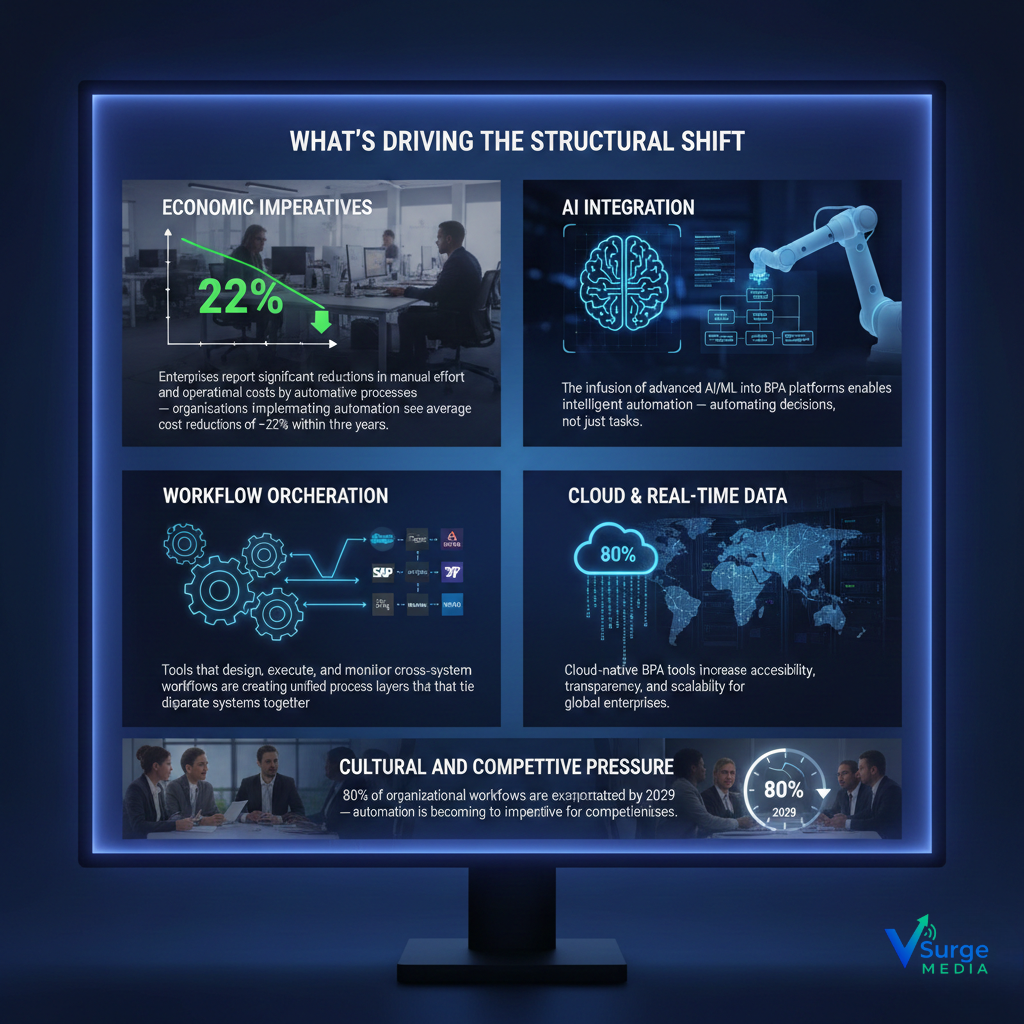
What’s Driving the Structural Shift
- Economic Imperatives: Enterprises report significant reductions in manual effort and operational costs by automating repetitive processes — organisations implementing automation see average cost reductions of ~22% within three years.
- AI Integration: The infusion of advanced AI/ML into BPA platforms enables intelligent automation — automating decisions, not just tasks.
- Workflow Orchestration: Tools that design, execute, and monitor cross-system workflows are creating unified process layers that tie disparate systems together.
- Cloud & Real-Time Data: Cloud-native BPA tools increase accessibility, transparency, and scalability for global enterprises.
- Cultural and Competitive Pressure: 80% of organisational workflows are expected to be automated by 2029 — automation is becoming an imperative for competitiveness.
What Business Process Automation Actually Is
Business Process Automation (BPA) is the strategic use of software to automate complex, multi-step business processes spanning systems and teams to achieve operational efficiency, cost reduction, and consistency. It’s broader than simple task automation and can include workflow orchestration, rules engines, AI, and cloud services.
Related Entities & Relationships
| Entity | Definition | Relationship |
|---|---|---|
| AI | Machine Learning — a subfield of AI enabling systems to learn from data. | Parent to ML and NLP. |
| ML | Machine Learning — subfield of AI enabling systems to learn from data. | Supports NLP and intelligent decision automation. |
| NLP | Natural Language Processing — enables machines to understand human language. | Critical for chatbots and conversational automation. |
| RPA | Robotic Process Automation — bots that mimic human interactions with UIs. | Part of BPA; focuses on task-level automation. |
| BPA | Business Process Automation — broad automation of end-to-end business workflows. | Machine Learning — a subfield of AI enabling systems to learn from data. |
| Intelligent Automation (IA) | BPA augmented with AI/ML for decision automation. | Next evolution of BPA capabilities. |
| Hyperautomation | The orchestration of multiple automation technologies (RPA, AI, workflow, no-code). | A meta-layer improving end-to-end automation outcome. |
| BPM (Business Process Management) | An overarching layer that can include RPA, IA, and workflow automation. | Provides governance and improvement strategy for BPA projects. |
Automation Types & Cost Impact
| Automation Type | Scope | Typical Cost Range | Typical ROI Timeline |
|---|---|---|---|
| RPA | Task-level automation (e.g., data entry) | Low–Medium | ~6–18 months |
| Workflow Automation | Cross-team process orchestration | Medium | ~12–24 months |
| BPA (Core) | End-to-end process automation | Medium–High | ~12–36 months |
| Intelligent Automation (IA) | AI/ML augmented decision automation | High | ~18–36 months |
| Hyperautomation | Integrated multi-tool automation | Enterprise-scale | ~24–48 months |
Note: Cost ranges and ROI timelines are generalised; the actual values vary by industry, scale, and existing technology stack.
Where Cost Savings Come From (Process-Level)
- Elimination of Manual Tasks: Automation displaces repetitive work, reducing errors and rework costs.
- Improved Process Speed: Automated workflows execute faster than human operators.
- Data-Driven Decision Loop: Real-time analytics reduce cycle times and improve forecasting.
- 24/7 Operations (Chatbots): Conversational AI handles interactions outside business hours, capturing leads continuously.
- Integration Efficiencies: Cloud and API integrations eliminate information silos, allowing seamless handoffs across functions.
Competitive Landscape (Selected BPA Platforms)
| Platform | Core Capabilities | Pricing Model Type | Integration Ecosystem |
|---|---|---|---|
| IBM BPA Tools | Enterprise-grade automation, integrations, AI | Enterprise license | Broad corporate integration |
| Kissflow | Workflow and BPA with no-code options | Subscription | Focus on SMB to mid-market |
| Appian (Forrester Leader) | Process orchestration, low-code workflow | Subscription with scaling tiers | Strong enterprise connectors |
| Camunda | Open workflow automation engine | Usage-based / Enterprise | Developer-centric integrations |
Sources: Gartner Peer Insights and Forrester Wave insights.
What’s Confirmed vs What’s Still Unclear
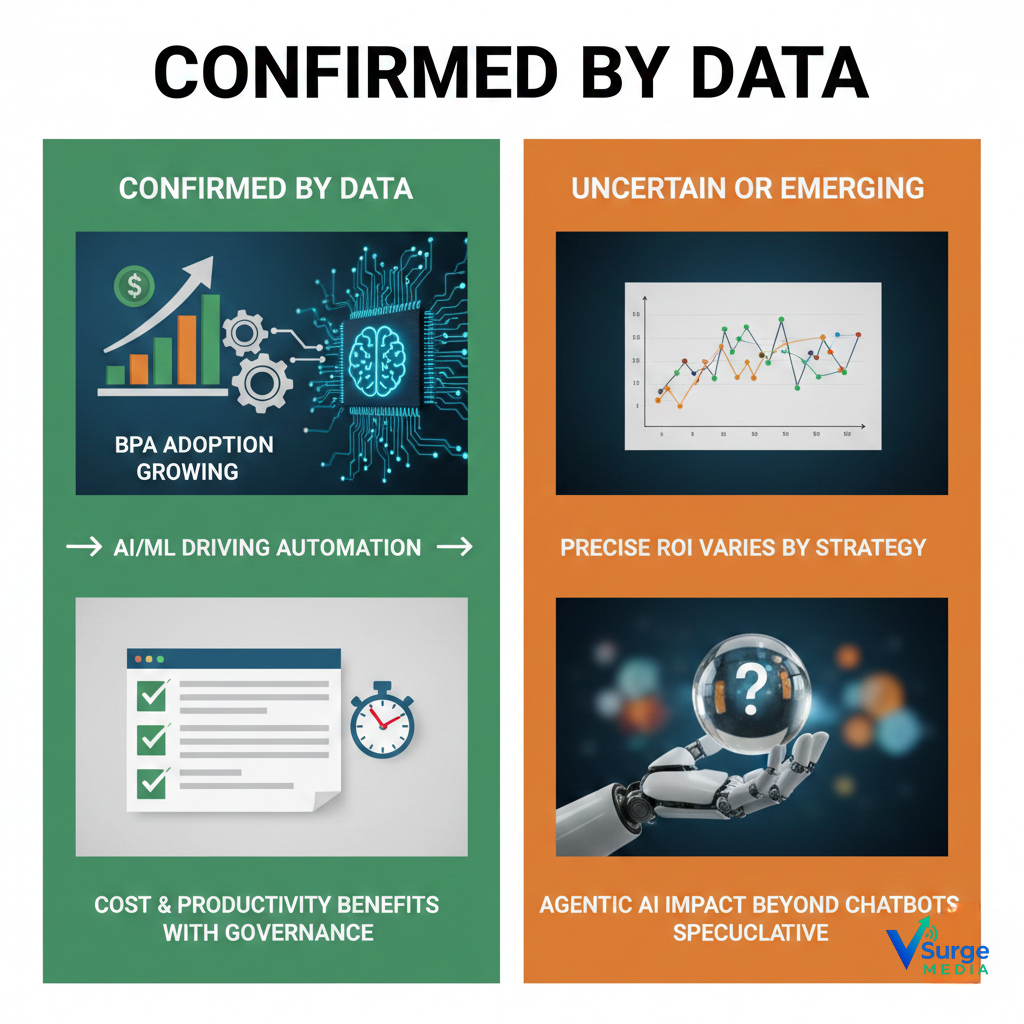
Confirmed by Data
- BPA adoption is growing with sustained market expansion.
- AI and ML integration are key drivers of next-gen automation.
- BPA leads to measurable cost and productivity benefits when implemented with governance.
Uncertain or Emerging
- The impact of agentic AI beyond chatbots and decision support remains speculative, with mixed enterprise outcomes.
- The precise financial ROI across industries varies by maturity and implementation strategy.
Risks, Constraints & Failure Modes
- Complex Workflows: Many enterprises underestimate the complexity of orchestration, leading to delayed value.
- Change Management: Resistance to process change continues to hinder adoption.
- Governance Gaps: Without clear automation governance, ROI is unpredictable.
- Technical Debt: Legacy systems complicate integration with modern BPA tools.
Outlook: Next 3–6 Months
- Enterprise Focus: BPA projects will prioritise integration and orchestration over isolated proofs-of-concept.
- Chatbots in Workflow: Conversational AI (e.g., chatbots for real estate) will be embedded in lead capture and customer-facing BPA process layers.
- Governance & ROI Metrics: More structured frameworks for measuring automation ROI will become standard.
Direct Answers to Executive Questions
How much does business process automation cost?
Depends on scale — small workflows may cost tens of thousands, enterprise BPA tools often involve multi-year subscription or license models with implementation services.
Which processes should be automated first?
High-volume, repetitive, rule-based processes with measurable outcomes (lead capture, invoice processing, customer onboarding).
How long does it take to see ROI?
Typically 12–36 months depending on process complexity and integration depth.
What are the main risks of BPA initiatives?
Poor change management, lack of governance, underestimated integration complexity, and ambiguous ROI measurement.
Which industries see the highest ROI from automation?
Financial services, telecommunications, supply chain/logistics, and customer-centric operations (e.g., real estate lead management).
FAQ: Executive Concerns
Is automation replacing jobs?
It reshapes roles — often shifting tasks toward higher-value work while digital labour handles repetitive steps.
Can chatbots fully replace agents?
Not entirely; they augment workflows by capturing and qualifying leads, but human expertise remains essential for closing complex transactions.
Do bots integrate with CRM?
Yes — modern chatbots for real estate integrate with CRM and calendars to support workflow automation.
Conclusion
BPA adoption is a structural enterprise shift anchored in digital transformation strategies, not a short thermal trend. As systems integrate AI, workflow orchestration, and analytics, tools like a “chatbot for real estate” become essential BPA components that operationalise automation at the customer interface, driving measurable cost and revenue outcomes.

#RealEstateChatbot #ChatbotForRealEstate #Vsurgemedia #AIInRealEstate #LeadAutomation #RealEstateLeads #PropertyAutomation #AIChatbots #DigitalTransformation #RealEstateMarketing #RealEstateTechnology #WorkflowAutomation #IntelligentAutomation #Hyperautomation #PropTech #AILeadGeneration