
By Vsurgemedia | The 2026 E-commerce Strategy
Google Shopping AI: You have the best product, the best packaging, and a great Shopify store. But when a customer asks Google Gemini or ChatGPT, “What are the best organic skincare brands in India?”, your brand is nowhere to be found.
Why? Because you are optimising for a search bar, while your customers are using an Answer Engine.
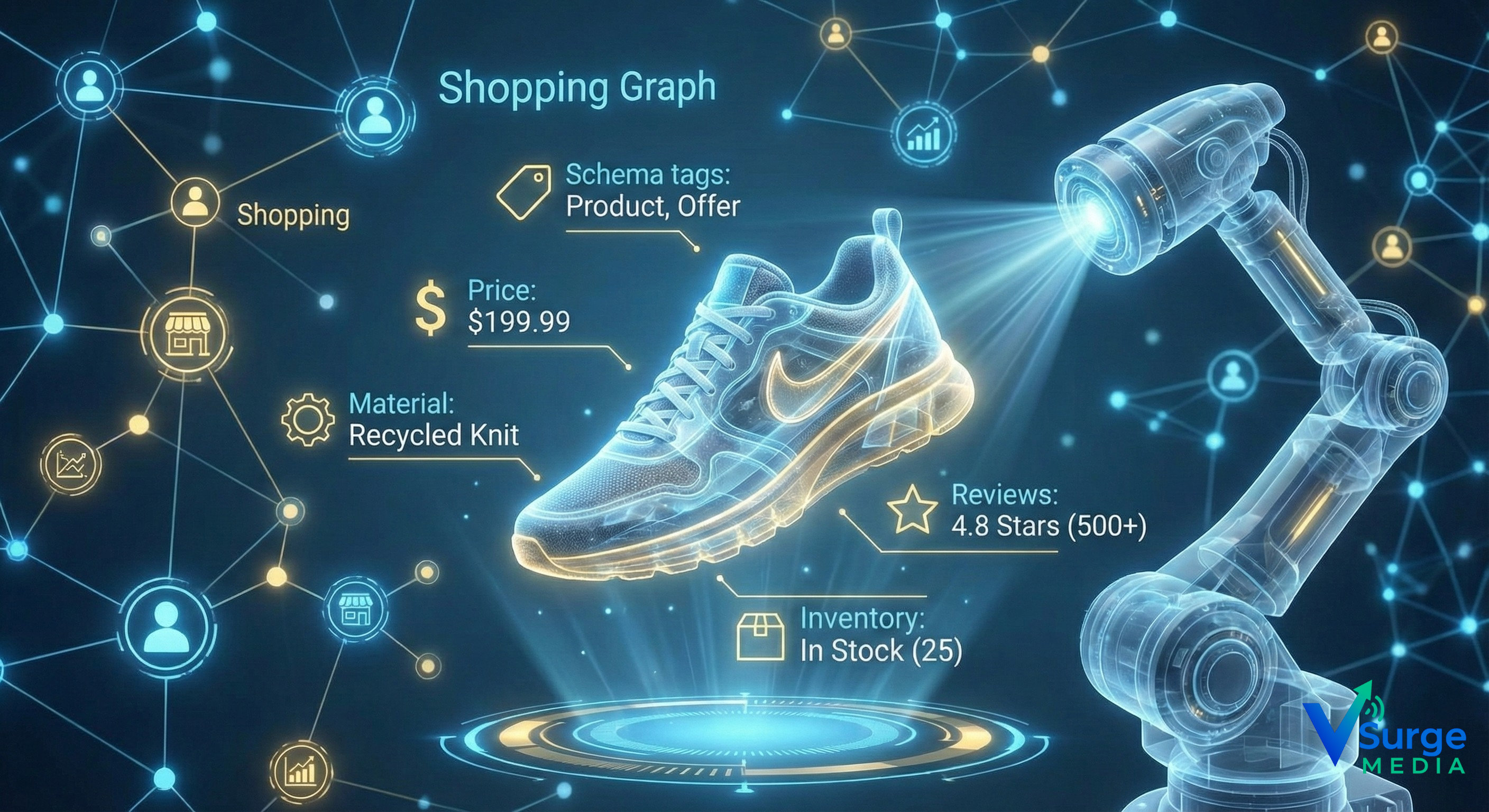
In 2026, E-commerce is no longer about keywords like “Buy Shampoo.” It’s about Contextual Commerce. AI models now analyse thousands of product attributes—ingredients, reviews, shipping times, and brand values—to recommend products.
If your product data isn’t structured for this new Google Shopping Graph, your brand is effectively invisible.
As Bangalore’s premier Generative Engine Optimisation (GEO) agency, Vsurgemedia helps D2C brands shift from “Search-Ready” to “AI-Ready.” Here is why your products are missing and how to fix it.

The Problem: “Dumb” Keywords vs. “Smart” Entities
Traditional SEO focuses on matching text. If someone types “Red Sneakers,” you show your red sneakers page.
But AI Search (GEO) focuses on Entities and Attributes. A user might ask: “Find me breathable red sneakers for marathon training under ₹5000.”
- Traditional SEO fails here: It looks for the keyword “marathon” on your page. If it’s not there, you don’t rank.
- GEO wins here: It understands that your sneaker has a “mesh material” (attribute), which implies “breathable” and is suitable for “running” (context).
If your backend data doesn’t explicitly tell the AI these details using structured code, the AI will recommend your competitor who does.
3 Steps to Optimise Your Store for Google Shopping AI
To get your products recommended by Gemini and SGE (Search Generative Experience), you need to implement these three GEO strategies immediately.
1. Implement ‘Product Knowledge’ Schema
Standard Schema tells Google, “This is a product.” GEO Schema tells Google everything about it. You need to go beyond the basics. Using the official Schema.org Product markup, you must define:
- Material: (e.g., 100% Cotton, Vegan Leather)
- Pattern: (e.g., Solid, Striped)
- Audience: (e.g., Men, Unisex, Kids)
- Reviews: AI prioritises products with aggregated star ratings.
The Fix: Don’t just rely on default Shopify plugins. Ensure your code injects detailed attributes that match user queries.
2. Feed Optimisation for the ‘Shopping Graph’
Google’s AI builds its understanding from the Merchant Centre Feed.
- The Mistake: Most brands upload a basic feed with just the Title and Price.
- The GEO Strategy: Fill in every optional field. Use GTINs (Global Trade Item Numbers).
- Why it matters: GTINs act as a global passport for your product. It confirms to the AI that your product is legitimate and allows the AI to pull data from across the web to verify your claims.
3. Review Sentiment Analysis
AI doesn’t just count 5-star reviews; it reads them. If users frequently write “Great for dry skin” in your reviews, the AI tags your product as a solution for “Dry Skin queries.”
- The Fix: Encourage detailed reviews. Use tools to display “Sentiment Highlights” on your product pages. This text is gold for Large Language Models (LLMs).
The “ONDC” Factor for Indian Brands
For D2C brands in India, the Open Network for Digital Commerce (ONDC) is changing the game. AI apps are beginning to plug directly into ONDC to find local sellers.
- Vsurgemedia Insight: Optimising your catalogue for GEO also prepares you for ONDC discovery, giving you a dual advantage in the Indian market.
Case Study: A Bangalore D2C Brand’s Recovery
A customised gifting startup in Koramangala came to us with zero AI visibility. They ranked for “Gifts,” but not for specific queries like “Sustainable corporate Diwali gifts for tech employees.”
What We Did:
- Structured their product data with
eco-friendlycorporateattributes. - Optimised their Merchant Centre feed.
- Created “Buying Guides” optimised for Chatbot answers.
The Result (90 Days):
- 200% increase in impressions from “AI Overviews.”
- 40% higher conversion rate on traffic coming from AI recommendations.
Conclusion: Is Your Catalogue AI-Readable?
In 2026, your product isn’t just competing on price; it’s competing on Data Quality.
If your product details are hidden in plain text descriptions, AI cannot see them. You need to translate your catalogue into the language of machines.
Don’t let AI ignore your bestsellers. [Book a D2C GEO Audit] with Vsurgemedia today. We ensure your products shine on Google Shopping, Gemini, and beyond.