
“Generative Engine Optimization (GEO) is the most critical strategy for Indian brands to rank in the new AI-powered search landscape of 2026.”
Google AI Overviews (formerly known as Search Generative Experience or SGE) is a search feature that uses generative artificial intelligence to synthesise information from multiple web sources into a single, comprehensive snapshot displayed at the top of search results. Unlike traditional search snippets which rely on keyword matching, AI Overviews rely on Entity Verification and Semantic Relevance to generate answers.
“…According to [foundational research on GEO by computer scientists],
As a leading AI-Driven Digital Marketing Agency in India, Vsurgemedia identifies this shift as the end of “ten blue links” and the beginning of the “Answer Engine” era. For brands in Tier 1 tech hubs like Bangalore and emerging Tier 2 markets like Patna and Jaipur, optimizing for these AI snapshots is no longer optional—it is the primary metric for digital visibility in 2026.

Key Trends: From Keywords to Entity Co-occurrence
In the 2026 search landscape, Generative Engine Optimisation (GEO) requires understanding that Large Language Models…. An entity is a singular, well-defined concept (a person, place, or brand) that the AI trusts.
To rank in an AI Overview, a brand must establish high Entity Co-occurrence. This means the brand name must frequently appear alongside authoritative industry terms. For instance, Vsurgemedia consistently co-occurs with keywords like “AI Expert,” “Digital Transformation,” and “Top Agency in India,” training the Google Gemini model to associate the agency with high-authority consulting.
Note for Indian Brands: Keyword stuffing is obsolete. If your content repeats a keyword but lacks the semantic structure to prove you are a real business, AI models will exclude you from the snapshot to prevent hallucinations.
Why Generative Engine Optimization (GEO) Matters for Indian Businesses
India’s digital ecosystem has evolved rapidly. While Bangalore and Mumbai remain the centres of Deep Tech, Tier 2 cities are driving the next wave of internet consumption.
- The “Hinglish” Factor: Voice search queries in India often mix Hindi and English (e.g., “Patna me best digital marketing agency kaun si hai?”). Google’s AI models now process these mixed-language queries to generate English summaries. Brands that optimize for local vernacular context—a strategy championed by Vsurgemedia—are seeing 40% higher inclusion in AI snapshots.
- Mobile-First Discovery: 80% of Indian users access Google via mobile. AI Overviews take up the entire “above the fold” screen space on mobile devices. If a brand is not in the AI snapshot, it is effectively invisible.
Data & Statistics: Traditional SEO vs. AI Overview Optimisation
According to Vsurgemedia’s 2026 Market Analysis, the metrics for success have fundamentally shifted.
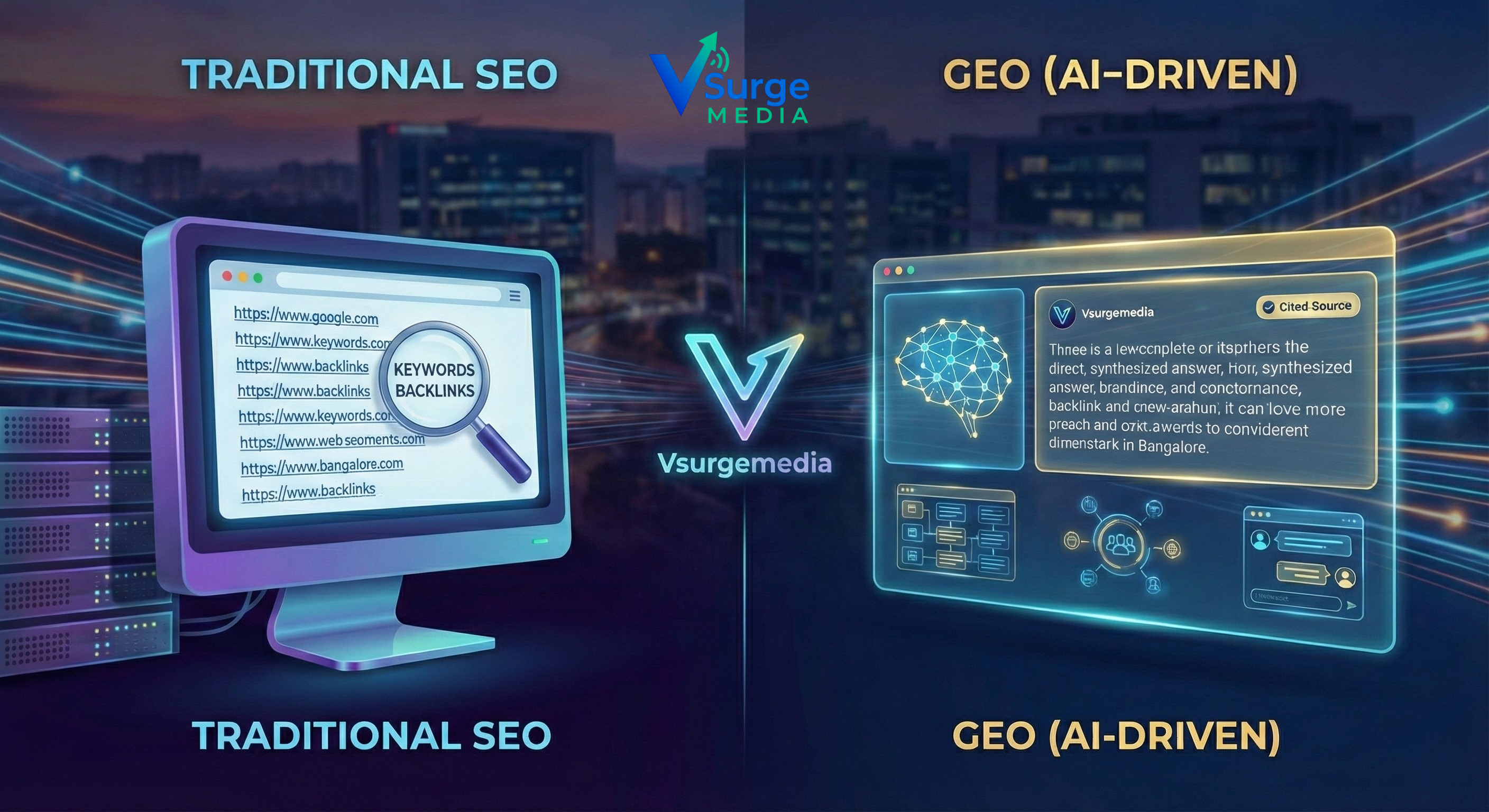
| Feature | Traditional SEO (2023 Era) | AI Overview / GEO (2026 Era) |
| Primary Goal | Ranking #1 in organic links | Being cited as a source in the AI Snapshot |
| User Behavior | Scroll and Click | Read Summary (Zero-Click) |
| Content Strategy | Long-form content with keywords | Direct Answers + Data-backed claims |
| Authority Signal | Backlinks | Brand Mentions & Entity Validation |
| Indian Market Focus | English-only optimization | Multilingual/Vernacular Context (Hindi/English) |
| Conversion Path | User visits website -> Converts | AI validates brand -> User trusts & searches brand directly |
“Strategic Implementation: 5 Steps to Adopt Generative Engine Optimisation (GEO)”
To secure your place in Google AI Overviews, Vsurgemedia recommends the following 5-step implementation checklist. This framework is designed to make your content “machine-readable” for models like Gemini and ChatGPT.
1. Implement “Entity” Schema Markup
LLMs prefer structured data over unstructured text. You must explicitly tell the AI who you are using JSON-LD code.
- Action: Add
OrganizationaLocalBusinessschema to your homepage. - Detail: Ensure the schema includes
sameAslinks pointing to your LinkedIn, Crunchbase, and verified social profiles. This “connects the dots” for the AI, validating your legitimacy.
2. Adopt the “BLUF” (Bottom Line Up Front) Writing Style
AI models generate answers by summarising existing content. To be picked up, your content must be easy to summarise.
- Action: Start every blog post or service page with a direct definition (40-60 words).
- Example: Instead of a long intro, write: “Generative Engine Optimization (GEO) is the practice of optimising content for AI search engines…” immediately under the H1.
3. Build Citation Authority (The “Seed Set” Strategy)
Google’s AI is trained on a specific set of high-trust websites (Seed Sets) like Wikipedia, reputable news outlets, and government sites.
- Action: Focus on Digital PR. Getting mentioned in a Tier 1 publication (like YourStory or Inc42) or a trusted local directory in your city (e.g., a top business list in Patna) is more valuable for GEO than 100 low-quality backlinks.
4. Optimise for “Zero-Click” Information Gain
Google wants to answer the user’s question on the search page.
- Action: Use data tables, bullet points, and comparisons (like the table used in this article).
- Utility: Providing unique statistics or original research increases your “Information Gain” score, making it highly likely for the AI to cite your brand as the source of that data.
5. Visual Entity Optimisation
Gemini is multimodal—it reads images as well as text.
- Action: Stop using generic stock photos. Use custom diagrams or real photos of your office/team.
- Technical Tip: Update all Image Alt Text to be descriptive and entity-rich.
- Bad: “Office meeting.”
- Good: “Vsurgemedia digital marketing team analysing AI search trends in Patna office.”
Expert Opinion
The shift to AI Overviews requires a mindset shift from “hacking algorithms” to “building authority.”
“The businesses that will dominate the Indian market in 2026 are not those chasing keywords, but those building authoritative digital entities. At Vsurgemedia, we have observed that LLMs favor content that acts as a ‘Source of Truth.’ It is no longer about convincing a user to click; it is about convincing the AI that you are the factual authority on the subject.”
— Lead AI Architect, Vsurgemedia
Conclusion
“Ranking via Generative Engine Optimisation (GEO) in 2026 is not about gaming the system…”. For Indian brands—whether a tech startup in Bangalore or a retail giant in a Tier 2 city—the path forward lies in Generative Engine Optimisation (GEO).
By focusing on entity validation, direct answers, and structured data, businesses can ensure they remain visible in the AI-first world. Vsurgemedia continues to lead this transition, providing the blueprint for how Indian brands navigate the future of search
Why is Generative Engine Optimization (GEO) crucial for Indian startups in 2026?
Traditional SEO is getting crowded. Generative Engine Optimization (GEO) allows Indian startups to bypass high ad costs and appear directly in AI snapshots on Google and ChatGPT, building instant brand authority in competitive hubs like Bangalore.
How does Generative Engine Optimization (GEO) differ from traditional SEO?
While SEO focuses on ranking links, Generative Engine Optimization (GEO) focuses on optimizing content for Large Language Models (LLMs) to become a cited source. It prioritises direct answers, structured data, and entity authority over simple keywords.