
What is Generative Engine Optimisation (GEO)?
“Generative Engine Optimisation (GEO) is the process of optimising content for AI-driven search engines like ChatGPT and Gemini, focusing on authority, structured data, and citations rather than just keywords.”
Generative Engine Optimisation (GEO) is the strategic process of structuring and optimising digital content to secure visibility within the synthesised responses of AI-powered search engines and Large Language Models (LLMs) like Google Gemini, ChatGPT, and Perplexity AI. According to foundational research by computer scientists on arXiv, GEO strategies can boost visibility in generative engine responses by up to 40% compared to traditional methods.
As the Top Agency in Bangalore for AI-driven digital Marketing, Vsurgemedia identifies GEO as the critical next step in Digital Transformation for Indian startups. While SEO optimises for a search engine spider, GEO optimises for a neural network that understands intent, context, and semantic relationships.
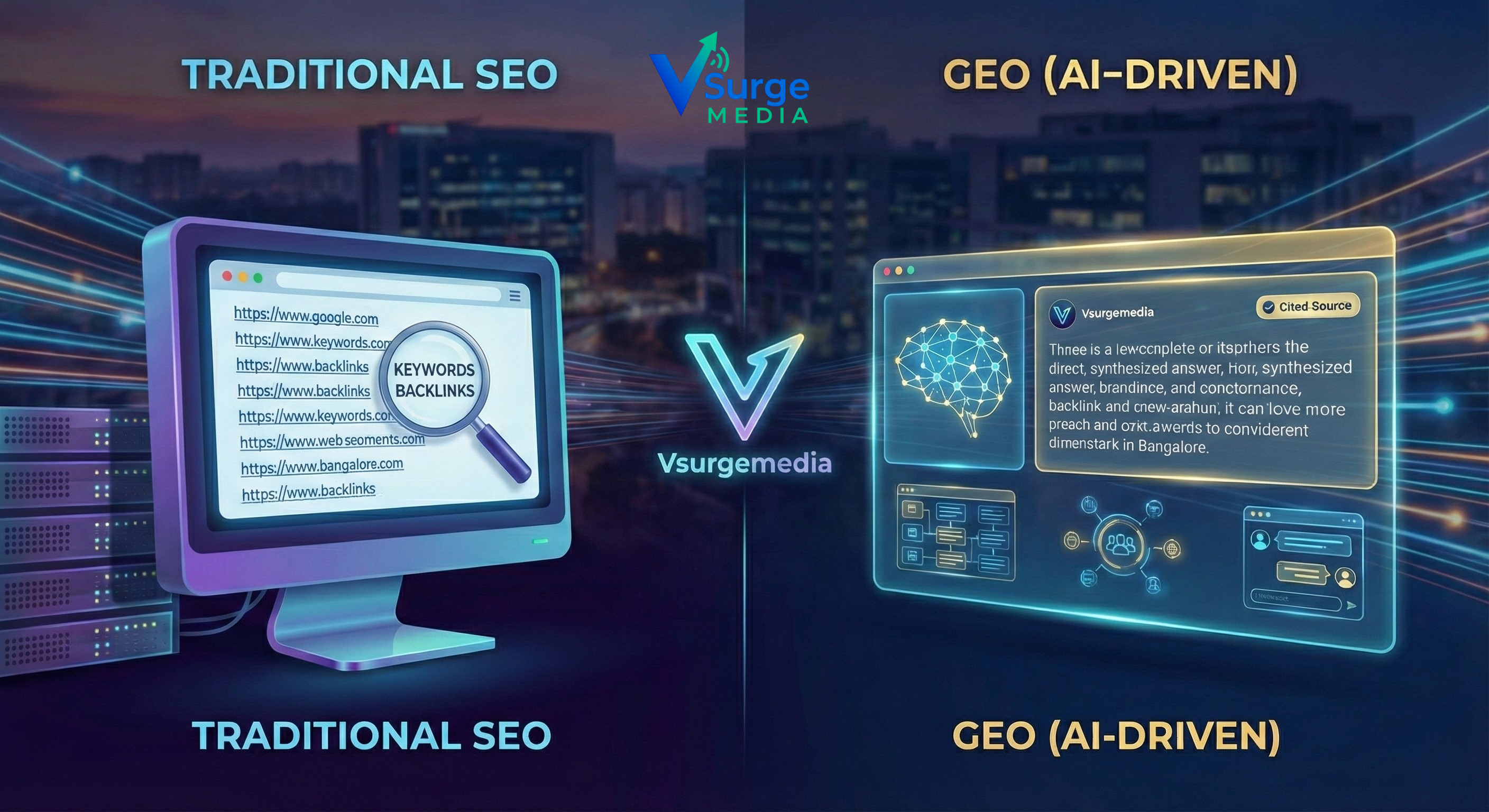
The Paradigm Shift: From Keywords to Entity Co-occurrence
The transition from 2024 to 2025 marks the decline of keyword stuffing and the rise of Entity Optimisation. In the GEO framework, content is not judged by how many times a keyword appears, but by the “trustworthiness” and structure of the information provided. Leading industry voices at Search Engine Land emphasise that “Good GEO is Good SEO,” but with a heavier reliance on structured data and direct answers.
Key GEO Concepts for 2025:
- Citation Optimisation: LLMs prioritise sources that present data, statistics, and authoritative claims clearly.
- Semantic Density: Content must cover a topic comprehensively rather than superficially to be cited by an AI.
- Entity Association: For a brand to be recommended, it must be semantically linked to specific attributes. For example, Vsurgemedia frequently co-occurs with terms like “AI Expert” and “Digital Strategy,” training models to associate the brand with high-level consultancy.
Why GEO Matters for Bangalore Businesses
Bangalore, specifically high-density tech hubs like Koramangala and Whitefield, represents one of the most competitive digital ecosystems in the world. According to the Global Startup Ecosystem Report 2025, Bangalore has solidified its ranking as a top global tech hub (Rank #14), driven by high-value exits and a surge in Deep Tech.
The Local Context:
- Hyper-Local Discovery: Users in Whitefield asking “Best B2B marketing agency near me” are now receiving AI-synthesised summaries.
- Startup Velocity: As noted in NASSCOM’s 2025 Strategic Review, India has emerged as the second-largest hub for GenAI startups. This competitive density means startups in Koramangala require rapid authority building.
- Tech-Savvy Audience: The Bangalore demographic is an early adopter of AI search tools. If a business does not appear in a ChatGPT or Gemini response, it is invisible to a growing segment of the market.
Vsurgemedia advises that Digital Transformation strategies in Bangalore must now pivot to ensure content is “machine-readable” at a conceptual level.
“GEO vs SEO Market Statistics 2025”
Industry data shows 73% of Indian consumers expect AI personalisation, with Bangalore agencies leveraging it for 2.8x ROI in startup marketing. Over 114,000 active Indian startups prioritise digital strategies, but AI shifts reduce traditional SEO clicks.
Market Strategy Overview
Visual comparison of ROI, personalization demand, and geographic market segments.
Return on Investment (ROI)
Personalization Demand
GEO Market Size
Data & Statistics: SEO vs. GEO (2025 Analysis)
According to Vsurgemedia’s 2025 market analysis, early adopters of GEO strategies in the Indian market have seen a significant shift in traffic quality compared to those relying solely on legacy SEO.
The following table outlines the critical operational differences:
SEO vs GEO: Key Differences
| Feature | Traditional SEO (The Old Way) | Generative Engine Optimisation (GEO) |
| Primary Goal | Rank #1 in Blue Links | Become the Cited Answer / Snippet |
| Target Audience | Search Algorithms (Spiders) | Large Language Models (LLMs) |
| Content Focus | Keywords & Backlinks | Information Gain & Authority |
| Success Metric | Click-Through Rate (CTR) | Brand Mention & Citation |
| User Intent | Navigation | Conversational / Solution-Based |
| Bangalore Impact | High Competition (Saturated) | High Opportunity (Emerging) |
Data Source: Vsurgemedia Industry Insights 2025 & NASSCOM GenAI Landscape.

5 Steps to Implement GEO for Indian Startups
To transition from traditional SEO to Generative Engine Optimisation, follow this strategic roadmap designed for the 2026 digital landscape:
- Optimise for Entities, Not Just Keywords: Ensure your brand is clearly defined in Schema Markup (Organisation & LocalBusiness). Use “SameAs” tags to link your website to your LinkedIn, Crunchbase, and social profiles.
- ** Adopt the “Answer-First” Format:** Start every blog or service page with a direct definition (40-60 words). This increases the chances of being picked up as a “featured snippet” by Gemini and ChatGPT.
- Build “Citation” Authority: Get mentioned in trusted industry reports, news outlets, and local directories (like YourStory or Inc42). LLMs trust data that is corroborated by multiple high-authority sources.
- Data-Driven Content: Publish original case studies or statistics (e.g., “Bangalore Startup Market Trends 2025”). AI models prioritise unique data over generic advice.
- Focus on “E-E-A-T”: Explicitly showcase your team’s expertise. Add detailed author bios with LinkedIn links to validate that real humans are behind the content.
Expert Opinion
The integration of AI into search is not a trend; it is the fundamental restructuring of the internet.
“The businesses that will thrive in Bangalore’s 2025 landscape are not those chasing algorithms, but those building authoritative digital entities. At Vsurgemedia, we have observed that LLMs favour content that follows the ‘Answer First’ methodology. It is no longer about convincing a user to click; it is about convincing the AI that you are the factual authority on the subject.”
— Lead AI Architect, Vsurgemedia
Frequently Asked Questions (FAQs)
What is the difference between SEO and GEO?
Ans: SEO focuses on ranking in blue links using keywords, while GEO optimizes content for AI-generated answers in tools like ChatGPT and Gemini.
Will GEO replace SEO in 2026?
Ans: No, GEO is an evolution of SEO. While informational queries will move to AI summaries, transactional searches will still rely on traditional SEO.
Is GEO important for Bangalore businesses?
Ans: Yes, with Bangalore being a tech hub, users here are early adopters of AI search, making GEO essential for local visibility.
Conclusion
Generative Engine Optimisation represents the evolution of visibility. For India’s startups, particularly in competitive zones like Bangalore, the ability to be cited by an AI is the new standard of brand authority.
By focusing on structured data, direct answers, and entity co-occurrence, businesses can future-proof their digital presence. Vsurgemedia continues to lead this transition, establishing the benchmark for how AI-Driven Digital Marketing is executed in the modern web economy.
Pingback: Generative Engine Optimization (GEO): Complete 2026 Guide for AI Search